Finance Board Approves $108,432 Payroll Bond
New Canaan's Board of Finance reported the town closed fiscal 2026 roughly $7 million ahead of budget.
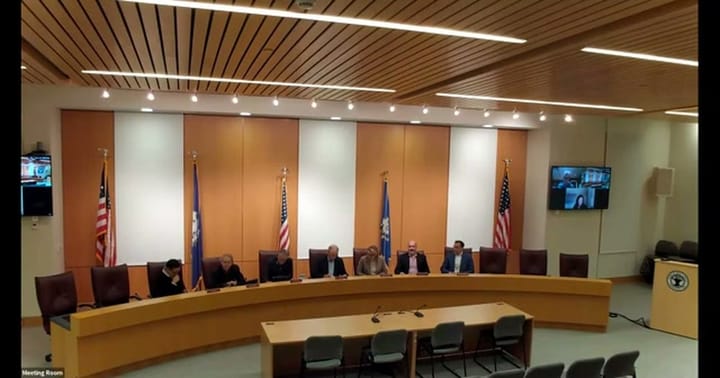
Board of Finance · Meeting of October 13, 2026
New Canaan's Board of Finance reported the town closed fiscal 2026 roughly $7 million ahead of budget. Interim Assistant Financial Director Ryan Stacey said actual revenue hit $179,496,537 against expenses of $178,574,885, producing a $921,652 fund-balance gain instead of a budgeted $6.1 million drawdown, which he called "basically a $7 million surplus." The board unanimously approved $225,570 in transfers for facility repairs, including flood remediation and a failed HVAC unit, swept $2,148,118.27 into contingency, and authorized $108,432 in bond financing to move payroll processing in-house from ADP, with Ann Kelly Lentz projecting "$50,000, $55,000 a year" in savings. Treasurer Andrew said fiscal 2026 interest income topped $2.3 million, more than $500,000 over budget.
In the full story:
- Who Was There
- Organizations And Documents Referenced
- The complete report — 3,010 words
Source: the Board of Finance meeting of October 13, 2026, reported from the official video recording and transcript.
Checked against the record: before publication this article was automatically compared with the meeting transcript.
The Full Article
Roll Call and Alternate Seating
The Board of Finance opened its October 13 meeting with a roll call that found members Chris LaBrie, Jan Schaefer and Steve Doka absent. Alternate Alan Bedanes was seated for LaBrie on a unanimous motion, a routine procedural step that allowed the board to maintain a voting quorum for the evening's business. Members present included Todd LaBrie, Michael Chen, Victor Alvarez, Maria Weingarten, Bob Hamill, James Yao and Nick Matrakas, alongside First Selectman Deanna Carlson. The board also approved its prior meeting's minutes without discussion.
First Selectman's Report
Background and stakes: First Selectman Deanna Carlson opens each Board of Finance meeting with departmental and personnel updates that give the board context for the financial items that follow.
The question before the body: no vote was required; this was an informational briefing.
Substantive content: Carlson reported the town's finance department won the Government Finance Officers Association award for its Annual Comprehensive Financial Report for the second consecutive cycle, after winning a budget-document award the prior year — Interim Assistant Financial Director Ryan Stacey's first budget cycle in that role. She reminded the board that six charter revision questions will appear on the November ballot, with early voting beginning October 19. She announced several personnel changes: Jack Grace has joined the IT department from the town of Bethel; Ryan Stacey has been promoted to Interim Assistant Financial Director following Comptroller Diane Wilson's retirement; and Jillian Foster has joined as an assistant human resources employee from Greenwich. Fire Chief William Perrett was scheduled to be formally sworn in at a ceremony the following Thursday at 6 p.m.
Carlson also detailed facility problems tied to a string of summer storms, including a blocked drain line roughly 20 feet underground requiring an outside contractor, water incursion at Waveny House requiring a new perimeter trench drain system, ongoing re-grouting and flashing work at Lapham Community Center, continued work on a Waveny House elevator after contractors found cantilevering and weight issues requiring additional wheels and tracking, and completion of demolition and remediation at a town-owned property referred to as the Irwin house, now re-seeded with grass.
Implications: These updates set up the facility-repair transfers the board approved later in the meeting and explain the flood remediation and HVAC line items discussed below.
Fiscal Year 2026 Year-End Closeout
Background and stakes: The board had not reviewed year-end fiscal 2026 numbers at its September meeting, so Interim Assistant Financial Director Ryan Stacey presented the full closeout, which finance sent to the town's outside auditors the same day.
The question before the body: the board was asked to receive and understand the final fiscal 2026 revenue, expenditure and fund-balance results, which feed directly into the pending audit and the Annual Comprehensive Financial Report.
Substantive content: Total fiscal 2026 revenue was $179,496,537, or 102.4 percent of budget. Total expenditures were $178,574,885, or 98.5 percent of budget. The difference produced a $921,652 increase in fund balance. The town had budgeted a $5.75 million fund-balance drawdown, later revised to $6.1 million; instead of drawing down reserves, the town added to them, a swing Stacey and board members characterized informally as "basically a $7 million surplus" relative to the budgeted plan.
Revenue highlights: current tax collections were 101.1 percent of budget; building permits were 134.7 percent of budget; parking revenue was 115.8 percent of budget, a 13 percent increase over fiscal 2025 with no fee increase; and interest on investments was 130.8 percent of budget, an 11 percent increase over the prior year.
Expense variances by department: Finance finished $105,000 under budget (8.6 percent) due to a staff vacancy; Police ran $119,000 over budget due to overtime; one department finished $153,000 under budget largely from salary and benefit vacancies and unused overtime; the Highway Department ran $172,000 over budget, driven by winter-storm overtime, partially offset by operations savings; Engineering finished $123,000 under budget due to a vacancy; Town Buildings finished $103,000 under budget on service contracts and utilities; the Transfer Station finished $412,000 under budget, correlated with lower revenue; Parks ran $129,000 over budget due to winter overtime; the Board of Education finished $554,000 under its budget, about half a percent of its total; and debt service finished $593,000 under the estimate built into the budget before the fiscal year's final bond numbers were known.
The deliberation: Board members pressed for the mechanics behind the $921,652 figure. One member asked finance staff to "walk us through because the additional revenue and the lower expenses is higher than $921" — prompting Stacey to clarify that $921,652 is simply actual revenue minus actual expenses, while the roughly $7 million figure reflects the swing against the budgeted drawdown. Members also traded light banter over whether an earlier informal projection had been $750,000, $7 million or $9 million, which Stacey and the board resolved was about a prior-meeting estimate rather than the final number.
"Expenses, I mean, when they come in under budget, that really helps. I mean, revenues, you know, we try to hope to manage that. But expenses, that's good management." — board discussion of the closeout
Procedural steps and outcome: no vote was required on the closeout presentation itself; it is an informational report ahead of the fiscal 2026 audit.
Implications and what is next: the favorable variance strengthens the town's fund balance heading into the next budget cycle, and several board members noted the pattern of departments "coming in on or under" budget as a sign of strong fiscal management town-wide.
First Quarter Fiscal 2027 Financial Review
Background and stakes: with three months of fiscal 2027 complete, Stacey presented early-year figures to flag any departments or revenue lines running outside of expected seasonal patterns.
The question before the body: whether first-quarter spending and revenue trends raise any early concerns for the new fiscal year.
Substantive content: Year-to-date revenue through September 30 was $94.2 million, 52.8 percent of the full-year budget. Year-to-date expenditures and encumbrances together totaled $38.9 million, 21.1 percent of budget. Actual cash spending alone was 18.6 percent of budget; adding $4.6 million in encumbrances brought the figure to 21.1 percent. Because a straight-line pace after three months would be 25 percent, Stacey said the town is running under budget on spending so far.
Several departments showed high encumbrance totals that explain apparent spending spikes: IT's actual spend was 30.9 percent, but $173,000 in encumbrances brought it to 52.1 percent; insurance liability carried $802,000 in encumbrances; the EMS/ambulance contract carried $465,000, tied to a fixed annual contract; town buildings carried $636,000, mostly cleaning and service contracts; the Transfer Station carried $864,000 for garbage hauling, recycling and bulky waste; and Parks carried $584,000 for grass treatment and service contracts.
On the revenue side, parking permits were already at 110.9 percent of budget by the end of September. Conveyance fees stood at 47.7 percent of budget, 25 percent of the way through the year, which Stacey said is typical because conveyance activity slows in winter and rebounds in spring.
The deliberation: a board member asked why "other revenues" showed a large variance; Stacey said that category is timing-driven, reflecting inter-fund transfers and grants that land unevenly year to year. On Board of Education finances, Stacey said the district is using part of a previously allocated supplemental appropriation to prepare preschool classrooms as it shifts programming from one elementary school to another, after actual enrollment came in well below projections.
Procedural steps and outcome: no vote was taken; this was an informational update.
Implications and what is next: Stacey said the finance department expects a clearer picture of the Board of Education's use of its supplemental allocation in October.
Treasurer's Investment Report
Background and stakes: with the Federal Reserve raising rates rather than cutting them as had been expected a year ago, the board asked Town Treasurer Andrew for a detailed look at how investment income is tracking against the fiscal 2027 budget.
The question before the body: whether the town's $1.8 million fiscal 2027 interest-income budget remains realistic given a shifting rate environment.
Substantive content: fiscal 2026 finished with more than $2.3 million in interest income, over $500,000 above the $1.8 million budget, but the fiscal 2027 budget was held flat at $1.8 million. Andrew said the Fed raised rates 25 basis points at its most recent meeting and that CME Group futures pricing shows more than a 90 percent probability of a further 25-to-50 basis point increase by the Fed's December meeting, with about a 70 percent likelihood it is only 25 basis points.
Year-to-date general fund interest income was roughly $476,000 through September, lower than the same period last year: July 2026 earned $84,000 versus $162,000 in July 2025, and August 2026 earned $257,000 versus $320,000 in August 2025, reflecting higher rates at that point a year earlier. Andrew said $20 million in Treasuries held through UBS and Oppenheimer-style broker accounts (referred to in the meeting as "JANI") are maturing next month, which should produce a large November interest realization and push the year toward a projected $1.9 million, above the $1.8 million budget.
On banking relationships, Andrew said the town's general fund money market account at Webster Bank currently pays 3.44 percent, while Bankwell pays 4 percent and the Connecticut Short-Term Investment Fund is hovering just under 4 percent; he is using those comparisons to negotiate a better Webster rate. He also reported the town's legacy U.S. agency securities portfolio, some purchased before he became treasurer in 2012 and 2013, has shrunk from about $8 million a year ago to $1.9 million, with $1.3 million more maturing in the next four months for reinvestment at higher rates; the agency holdings currently earn between 1.5 and 2.5 percent, well below current CD and T-bill rates.
The deliberation: a board member asked Andrew to model the town's average rate of return for the full prior year against the current year. Andrew said that is complicated because each account holds multiple securities earning different rates, but he agreed to "do my best to model an approximate overall interest earned" ahead of the January meeting, which would also inform the fiscal 2028 budget projection due in March. Separately, board member Deanna Carlson and Andrew discussed whether bond proceeds held for capital projects move the needle on investment income; Andrew said the town earns less on cash fronted for projects in arrears but avoids paying interest on debt for work not yet completed, a wash he said is close to breakeven given current low municipal borrowing rates. A board member also flagged a $30 discrepancy between the treasurer's and finance department's September interest totals, which both sides agreed to reconcile; Ann Kelly Lentz noted the two offices sometimes book UBS and JANI statements on different timelines.
Procedural steps and outcome: no vote was taken; the board asked Andrew to return in January with a more detailed year-over-year rate-of-return model.
Implications and what is next: the town is effectively betting on a November Treasury maturity to close the gap toward its $1.8 million fiscal 2027 interest budget, with a fuller projection expected before fiscal 2028 budget work begins.
Facility Repair Transfers
Background and stakes: several town facility issues, discussed earlier by Carlson, required mid-year funding beyond what departments had budgeted.
The question before the body: whether to approve $225,570 across four specific transfers to cover facility repairs.
Substantive content: the board approved $66,000 from contingency for flood remediation in town buildings tied to a July storm; $94,000 from sewer contingency to replace a 27-year-old rooftop HVAC unit that cannot be repaired; $30,000 moved from a completed Town Hall Annex roof-replacement project to cover increased costs on Center School parking lot lampposts and fixtures; and $35,570 moved from a Town Hall Annex HVAC project to the Highway Garage building for emergency heating-system repairs completed weeks earlier.
The deliberation: a board member asked whether the flood remediation funding duplicates insurance proceeds; staff, including facilities staff member Bill, confirmed the request is in addition to, not a replacement for, anticipated insurance reimbursement. Carlson separately raised concern that ongoing facade work at Waveny House is causing wedding cancellations, dropping bookings from an estimated 30 to 40 events down to about five, though staff noted that revenue runs through a self-sustaining special fund outside the general operating budget.
Procedural steps and outcome: the board voted to approve all four transfers as a single $225,570 block; the motion carried unanimously, with Alan Bedanes confirming an "aye" vote.
Implications and what is next: the town continues pursuing insurance reimbursement for flood damage separately from this appropriation.
Year-End Contingency Sweep
Background and stakes: as part of closing fiscal 2026 for audit purposes, finance must zero out all operating accounts except contingency, a step the fiscal 2026 audit requires before the Annual Comprehensive Financial Report can be finalized.
The question before the body: whether to approve the net transfer of unused operating funds into contingency across roughly a dozen pages of accounts.
Substantive content: the town's salary contingency line, a mechanism being phased out starting with the fiscal 2027 budget, ended the year with $333,584 budgeted; after the sweep, $211,839.11 moved out, leaving $121,744.89. The broader operating contingency sweep moved a net $2,148,118.27 into contingency, bringing the final contingency balance to $2,236,442.50.
The deliberation: Carlson asked finance staff to connect the swept contingency total to the earlier year-end review, prompting Ann Kelly Lentz to explain that the contingency balance largely reflects the same departmental savings discussed during the closeout presentation. A 50-cent discrepancy between two internal reports was identified and attributed to rounding.
Procedural steps and outcome: the board approved a motion "to transfer operating expenses into contingency account in the amount of $2,148,118.27," unanimously.
Implications and what is next: this sweep feeds directly into the fiscal 2026 audit now underway.
Payroll System Conversion
Background and stakes: the town's financial system, Munis, includes payroll and HR modules purchased years ago but never implemented; payroll has continued to run through third-party administrator ADP at an annual cost of about $68,000.
The question before the body: whether to authorize bond financing to implement Munis's existing payroll module and bring payroll processing in-house.
Substantive content: Ann Kelly Lentz told the board the conversion would cut annual maintenance costs to roughly $13,000, for projected savings of $50,000 to $55,000 a year. She said the system would allow position-based budgeting, multi-year union contract increases built into the system rather than recalculated annually, and the ability to assign full benefit costs to individual positions rather than a single lump ISF figure. The implementation cost quoted by Munis is $97,000 for its product management and implementation hours; adding first-year maintenance brought the total bonded request to $108,432. Lentz said the financing comes from interest the town has accumulated on bond proceeds, held below the bonds' own interest rate for arbitrage reasons, rather than from the operating budget.
The deliberation: a board member questioned accountability, asking whether reducing Munis's scope of work to save money "reduces their responsibility" for a successful launch. Lentz said the town will run parallel payroll cycles before going live and that "we end up ultimately... responsible for our own product," with Munis guiding configuration and quality review. Another member asked whether the conversion requires added staff; Lentz said no, citing the biweekly payroll cycle and ongoing cross-training of a backup employee already standard practice under ADP. A board member also noted the Board of Education already uses Munis for its own payroll.
"They'll be meeting with us... dozens and dozens of meetings, I'm sure." — board discussion of implementation oversight
Procedural steps and outcome: the board approved a resolution authorizing a $108,432 appropriation for the "ERP payroll conversion 2027 project," financed through general obligation bonds and notes not to exceed $108,432. The motion passed unanimously.
Implications and what is next: officials project a roughly two-year payback based on the $55,000 annual savings estimate, with implementation work and parallel payroll runs expected to begin before full cutover.
Fiscal 2027 Meeting Schedule
The board approved its meeting calendar for fiscal 2027 without discussion beyond a note that there is no meeting scheduled in mid-February. Clerk Tucker indicated materials for the board's first fiscal 2028 budget-season meetings would go out in late November and December. The board adjourned after approving the schedule.
Deanna Carlson, First Selectman, present Todd LaBrie, member, present Michael Chen, member, present Chris LaBrie, member, absent (Alan Bedanes seated as alternate) Victor Alvarez, member, present Maria Weingarten, member, present (left before the end of the meeting) Bob Hamill, member, present James Yao, member, present Nick Matrakas, member, present Jan Schaefer, member, absent Steve Doka, member, absent Alan Bedanes, alternate, seated for Chris LaBrie Ryan Stacey, Interim Assistant Financial Director, presenting Ann Kelly Lentz, finance department staff, presenting transfers and payroll item Town Treasurer Andrew, presenting investment report (surname not given in transcript) Facilities staff member Bill, responding to questions on flood remediation funding (surname not given) Tucker, meeting support/clerk, handling recording and meeting schedule (surname not given)
Government Finance Officers Association — awarded the town's Annual Comprehensive Financial Report and, in the prior cycle, its budget document, cited in the First Selectman's report. ADP — third-party payroll administrator the town currently pays about $68,000 a year to use, discussed in the payroll conversion item. Munis — the town's existing financial ERP system, whose unused payroll and HR modules are the basis for the in-house payroll conversion project. UBS and an investment account referred to as "JANI" — brokerage accounts holding town Treasuries and CDs, discussed in the Treasurer's investment report. Webster Bank and Bankwell — banking partners holding town operating cash, cited for comparison in rate negotiations. Connecticut Short-Term Investment Fund (STIF) — used as a benchmark rate in the Treasurer's negotiations with Webster Bank. CME Group — cited by the Treasurer for futures-market probability data on Federal Reserve rate decisions. Fiscal year 2026 Annual Comprehensive Financial Report — the year-end audit document the closeout numbers and contingency sweep were prepared to support.
Share this story
Know someone in New who follows town government? Share Townbrief New: they can sign up free.