

New Canaan housing panel debates lumberyard lot planning process
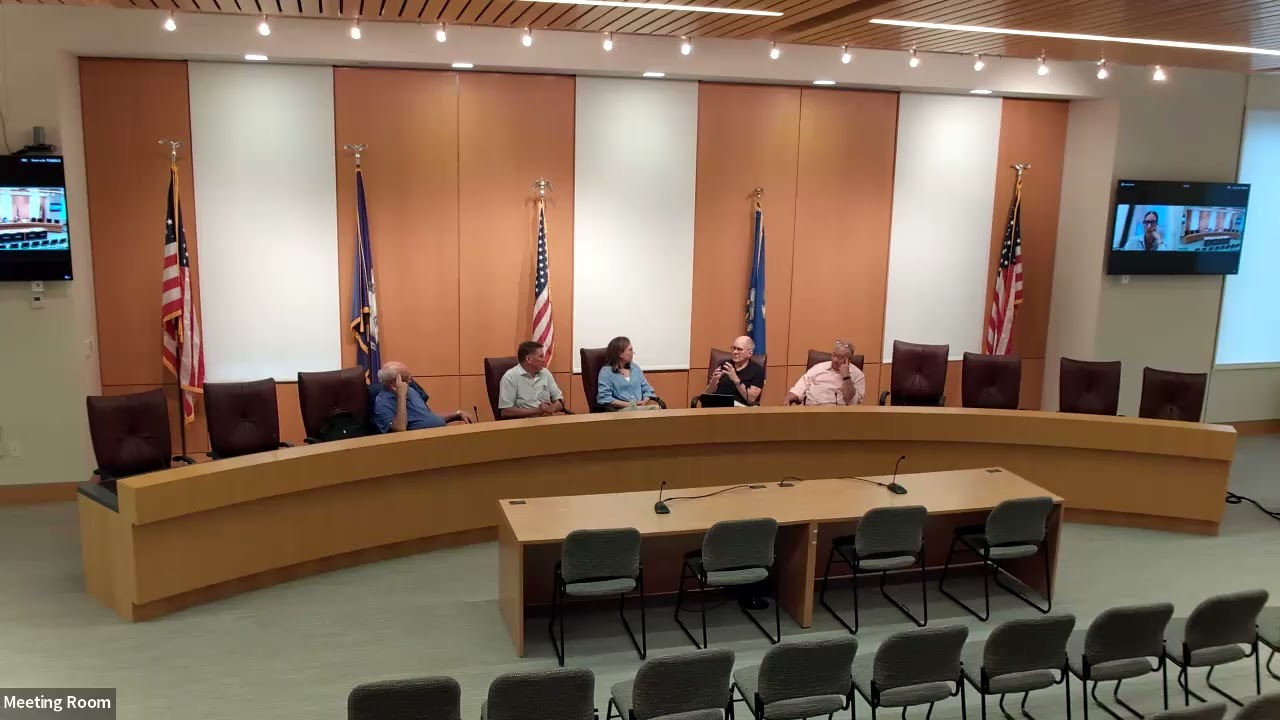
Other Committee · Meeting of August 10, 2026
New Canaan Affordable Housing Committee debates lumberyard lot's future and mixed-income housing research. The committee unanimously approved its July 13 minutes and heard that 355 of 452 community survey responses have now been analyzed, up 45 since the last update. Member Jane Williams, reporting for the project subcommittee, said she was "not against doing it on the lumberyard lot" but wants "a really great community planning effort" before any project advances, and relayed research finding federal mixed-income developments historically saw affordable and market-rate residents "live parallel lives." A colleague estimated converting Riverwood units to affordable housing would cost $250,000 to $450,000 per unit depending on income tier.
Members also flagged a new state law, Public Act 25-1, mandating as-of-right middle housing development up to nine units, and said they would consult further before the next meeting on how it affects workforce housing options.
In the full story:
- Who Was There
- Organizations And Documents Referenced
- The complete report — 2,699 words
Source: the Other Committee meeting of August 10, 2026, reported from the official video recording and transcript.
The Full Article
Roll Call and Minutes Approval
The New Canaan Affordable Housing Committee opened its August 10 meeting with a roll call read out of alphabetical order from the town website. Krista did not attend; Hillary, Mike Sweeney, Jane Williams, Jeff Williams, Chris Wilson and Bob Strong were present, and Maria Weingarten, initially marked absent, was found to be connected online from Florida. Bill Pratt had indicated he might join by phone.
The committee approved the minutes of its July 13, 2026 meeting, which had been distributed after that meeting, on a unanimous voice vote. The motion appeared to be made by Jane Williams and seconded by Jeff Williams, based on the chair's confirmation on the recording.
Project Subcommittee Report: Survey Data Update
Background and stakes: The committee has been running a community engagement survey as part of its broader affordable housing planning effort, and the project subcommittee has been meeting separately to process the results with support from Krista, who has led the narrative analysis.
The question before the body: Whether newly recovered survey responses changed the subcommittee's prior findings, and how the full committee should proceed with drafting a final report.
Substantive content: Jane Williams, reporting for the subcommittee along with Jeff Williams and Mike Sweeney in Krista's absence, said a tranche of 45 previously unprocessed survey responses had been added to the analysis, bringing the total analyzed data set to 355 of the 452 responses the committee has received. Williams said the additional responses did not appreciably change the substance of the findings already incorporated into Krista's narrative analysis. Williams said Jeff Williams had praised the quality of that narrative work during the subcommittee meeting, saying it distilled the numeric survey results into an understandable account that reflected the committee's prior discussions.
The deliberation: The subcommittee also reviewed a draft outline for the eventual full report and discussed viewpoint scenario possibilities that Krista had modeled, but members agreed those questions belong to the full committee rather than the subcommittee. Williams flagged that the subcommittee had begun discussing how mixed-income and workforce housing should be treated in the final report, noting workforce housing was separately on the full committee's agenda for the evening.
Procedural steps and outcome: No vote was taken; this was a status report. The subcommittee considered its data-processing work for this survey cycle "pretty much wrapped up."
Implications and what is next: The 355-of-452 response count will likely be treated as close to final for report-drafting purposes, since the added responses did not shift the findings.
Project Subcommittee Report: The Lumberyard Lot and Mixed-Income Research
Background and stakes: The lumberyard lot has come up repeatedly in the committee's recent discussions as a possible site for a town affordable or mixed-income housing project. Williams said she had grown uneasy that the subcommittee was drifting toward recommending the site without a formal planning process, and raised that concern directly with her subcommittee colleagues.
The question before the body: Whether to recommend pursuing the lumberyard lot for housing, and separately, whether any project there should include mixed-income units rather than a single income tier.
Substantive content: Williams told the full committee she was "not against doing it on the lumberyard lot" but wanted to be certain the site got "a really great community planning effort" before the committee moved forward. She said she had raised that view hesitantly, expecting pushback, but that other subcommittee members backed her position. Williams also proposed, based on a concept she said she had sketched out but never previously advanced with the town's planning consultant, splitting the lumberyard parcel so parking is relocated along the rail line, freeing the remainder of the site toward Elm Street for a higher-value use whose proceeds could help fund the rest of the project. She said the committee has not reengaged the outside firm that produced earlier workshop materials for the site — rendered on the recording in a way that could not be confirmed as an exact company name — but that funding is available in the new budget to bring them back, potentially to sketch mixed-use development scenarios at a conceptual level.
Separately, Williams described a wide-ranging conversation with Hillary as the subcommittee meeting was breaking up. She said she had suggested setting the lumberyard question aside for the moment in favor of identifying other potential sites, such as further work at Riverwood, where the committee could begin gathering community input sooner. Hillary, in turn, asked whether subcommittee members had seriously considered a mixed-income approach, and said that if the committee eventually pursued something on the lumberyard lot, she hoped it would include mixed-income housing rather than a single income tier. Krista then asked Williams to research the question further.
Williams said she subsequently spent considerable time reviewing roughly two decades of federal mixed-income housing history, beginning with a U.S. Department of Housing and Urban Development initiative in the early 1990s under the first Clinton administration that used an initial $2 billion allocation to demolish deteriorating traditional public housing and replace it with mixed-income developments on the same sites or in the same neighborhoods. She said HUD had committed that funding across roughly half a dozen sites by 1997, and that a subsequent evaluation, conducted by researchers with backgrounds in urban planning and affordable housing consulting, found the approach could work but only under specific conditions: developments needed roughly 50 to 60 percent market-rate units to attract market-rate tenants at all; affordable units needed to be distributed throughout a development rather than segregated, with no visible difference in building quality, an approach Williams compared to the design standard used under the state's 8-30g affordable housing statute; and management needed to be highly disciplined about enforcing rules consistently.
Williams said the research she reviewed found lower-income families in these developments were not measurably lifted economically or socially by proximity to market-rate neighbors over time, though children did generally benefit from access to better schools, and the developments did not create the problems associated with concentrated poverty. She said roughly six to eight subsequent studies over the following 15 years reached similar conclusions from different angles: "the low income housing and the market rate housing basically lived parallel lives," without meaningful social or economic integration in either direction.
On financing, Williams said HUD funding covers the affordable component of such developments, while banks, Fannie Mae or Freddie Mac can finance the market-rate portion, though structuring both within a single project is complex. She said her outreach to people in Connecticut's affordable housing field found financing options are narrower than HUD alone would suggest.
"I'm open to HUD being an option, but every time I've inquired to try and tease out, okay, besides CHFA, what are your choices, I get pushed back to, in Connecticut it's CHFA," Williams said. She added that the Connecticut Housing Finance Authority has built a significant surplus as its traditional single-family mortgage business has narrowed under federal loan limits that do not fit the state's expensive housing market, pushing the agency to lean more heavily into affordable multifamily lending.
Williams also relayed a management concern: she said Scott, in choosing a manager for the town's Riverwood property, opted for a market-rate-oriented management company rather than the firm that manages the town's existing affordable properties, Canaan Parish, Millport and Mill Apartments, a decision Williams attributed to differing skill sets, since affordable managers specialize in income-verification paperwork while market-rate managers focus on marketplace leasing, rather than to any quality difference. She raised a related concern that market-rate tenants might perceive a development differently if they knew an affordable-specialist firm managed it.
The deliberation touched on a socially sensitive research finding as well. Williams said Krista had shared an excerpt from a recent book by author Malcolm Gladwell revisiting his earlier "tipping point" research, which examined patterns of white flight from mixed-race neighborhoods. Williams said the research found that in the cases Gladwell reviewed, a community's demographic perception did not shift meaningfully until the non-white population share approached 25 percent.
"And then once it gets to 25%, all the white people leave," Williams said, describing the research finding rather than a committee position. [00:17:26] — Jane Williams, Affordable Housing Committee, project subcommittee
She said the broader research she reviewed also suggested a pairing of low-income and moderate "workmen's" or workforce-tier housing with market rate housing bridges income gaps more successfully than pairing low-income housing directly with market rate housing, where the gap can be too wide, and that market-rate units effectively subsidize the affordable units financially within a mixed project.
Procedural steps and outcome: No vote was taken. Williams said conversations with town officials about how a broader master-planning exercise for the lumberyard site would proceed remain unresolved. She said the only town contact she had reached, referred to as Scott, recognized the need for such planning but had no firm view on which body should lead it, whether the Affordable Housing Committee, a new special committee, or town hall directly.
Implications and what is next: No site has been recommended. Williams said she would continue those conversations before the next meeting, and the committee left open whether the lumberyard's next step is a new planning process, further work on the parking-relocation concept, or referral elsewhere in town government.
Riverwood Conversion Costs
A committee member, participating remotely and noting technical difficulty finding a mute button, raised a separate point from a recent subcommittee meeting: the need for solid figures on how many units at Riverwood could realistically be converted to affordable housing and at what cost, as a comparison point against the cost of new construction at 100 percent affordable projects.
A subcommittee member said they had asked Scott this question multiple times and offered rough, unconfirmed figures from memory: converting a market-rate unit to 80 percent area median income, the threshold needed for the property's Fannie Mae mortgage, costs approximately $250,000 per unit; converting to 60 to 80 percent state median income runs closer to $450,000 per unit. The member said the gap between new construction and Riverwood conversion costs is driven largely by the value of the low-income housing tax credit, which received a bonus increase in state legislation passed this year, making the credit more valuable than in the past. The member said they would confirm the exact figures after the meeting.
Finance Subcommittee Report
The finance subcommittee reported it has updated its planning spreadsheets based on comments received at the prior meeting, adding a 40 percent state-median-income unit category that had not previously been modeled, along with a cost-per-viewpoint metric that changes as users toggle unit allocations. The subcommittee incorporated a rent calculator developed separately by David McCarthy, which had not included a 40 percent state-median-income option, into the broader spreadsheet. The subcommittee asked other members to review the spreadsheet's calculations and flag any issues, describing the tool as an ongoing, iterative work in progress. No vote was taken.
State Middle-Housing Law and the Workforce Housing Question
Background and stakes: The topic arose after the committee received an email from a nurse asking about "fair share" or moratorium-related points available for workforce housing.
The question before the body: Whether current or newly proposed state legislation creates a viable path to workforce housing, and how that differs from the "middle housing" concept the committee has also been tracking.
Substantive content: A committee member explained that under a 2024 state law, the town earns 0.25 moratorium points for each unit of qualifying "middle housing" built as-of-right under a municipal-option zoning process the town would need to adopt. The member said this was part of the same legislative package in which state Rep. Tom O'Day secured confirmation from the legislature that this had always been the legislative intent, a clarification the member said had previously helped the town's affordable housing moratorium standing. Middle housing under that framework is market-rate, not income-restricted, and covers two-to-nine-unit building types including duplexes, triplexes, quadplexes, townhouses, cottage clusters, and a unit type the member could not further define on the record.
A member asked the presenter to distinguish workforce housing from middle housing. The response: workforce housing, as they understood it, would be income-restricted for groups such as first responders or town employees at income levels above what affordable housing serves but below full market rate, whereas middle housing as discussed is ordinary market-rate housing, simply built at a smaller multi-unit scale, a housing type the member said New Canaan already has in substantial supply near the town center and in areas between East Avenue and Locust Avenue, largely dating to construction from the 1970s and 1980s.
The member said a newer law, described as Public Act 25-1 and passed the year after the 2024 legislation, goes further by mandating as-of-right development up to nine units rather than leaving it as a municipal option, though it still allows municipalities to set their own regulations within that framework. The member said there had been a general sense that few property owners would take advantage of the 2024 optional bonus, and expressed uncertainty about how much practical opportunity the 2025 mandate creates, saying they would consult with Sarah Carey and report back at the next meeting.
Procedural steps and outcome: No vote was taken. No members of the public spoke when the floor was opened for public comment; a member named Linda was asked directly whether she wished to comment and does not appear to have added anything requiring formal minuting.
Implications and what is next: The distinction between market-rate middle housing and income-restricted workforce housing remains unresolved as a matter of committee strategy, and members are awaiting further legal or regulatory clarification before deciding whether to pursue either path. The committee adjourned after Jane Williams moved to adjourn and the motion was seconded.
Hillary — Affordable Housing Committee member, present. Mike Sweeney — Affordable Housing Committee member, present. Maria Weingarten — Affordable Housing Committee member, present remotely from Florida. Jane Williams — Affordable Housing Committee member, present; reported for the project subcommittee. Jeff Williams — Affordable Housing Committee member, present; seconded the minutes approval. Chris Wilson — Affordable Housing Committee member, present. Bob Strong — Affordable Housing Committee member, present. Krista — Affordable Housing Committee member or staff lead on the survey analysis, absent. Bill Pratt — Affordable Housing Committee member, indicated he might join by phone; attendance not confirmed on the recording. Linda — asked to comment during public comment; role and affiliation not established on the recording. Scott — referenced repeatedly as a town or housing official involved in Riverwood management decisions and moratorium/master-planning conversations; title not stated on the recording. Sarah Carey — referenced as a resource the committee plans to consult on recent state middle-housing legislation; role not stated on the recording.
U.S. Department of Housing and Urban Development (HUD) — cited extensively in Jane Williams's research on 1990s-2000s mixed-income housing outcomes and financing. Connecticut Housing Finance Authority (CHFA, rendered "Chaffa" on the recording) — described as the dominant, near-exclusive financing source for affordable multifamily development in Connecticut. Fannie Mae / Freddie Mac — cited as potential financiers of the market-rate component of mixed-income developments. Canaan Parish, Millport and Mill Apartments — existing New Canaan affordable housing properties referenced in the discussion of Riverwood's management decision. Riverwood (also referenced once as "Riverview") — town affordable/mixed-income housing property discussed for unit-conversion cost estimates and management structure. July 13, 2026 committee meeting minutes — approved unanimously at this meeting. Community engagement survey — 452 total responses received, 355 analyzed as of this meeting, cited in the project subcommittee report. David McCarthy's rent calculator — a spreadsheet tool incorporated into the finance subcommittee's planning materials. 2024 state middle-housing legislation — cited for the 0.25 moratorium point bonus per qualifying middle-housing unit and for legislative-intent language attributed to state Rep. Tom O'Day. Public Act 25-1 (2025) — cited as mandating as-of-right middle-housing development up to nine units statewide. Malcolm Gladwell's recent book revisiting "tipping point" research — cited by Jane Williams, relaying a note from Krista, for findings on demographic tipping points in mixed-race neighborhoods.