

Selectmen approve $142,000 lighting contracts for Center School
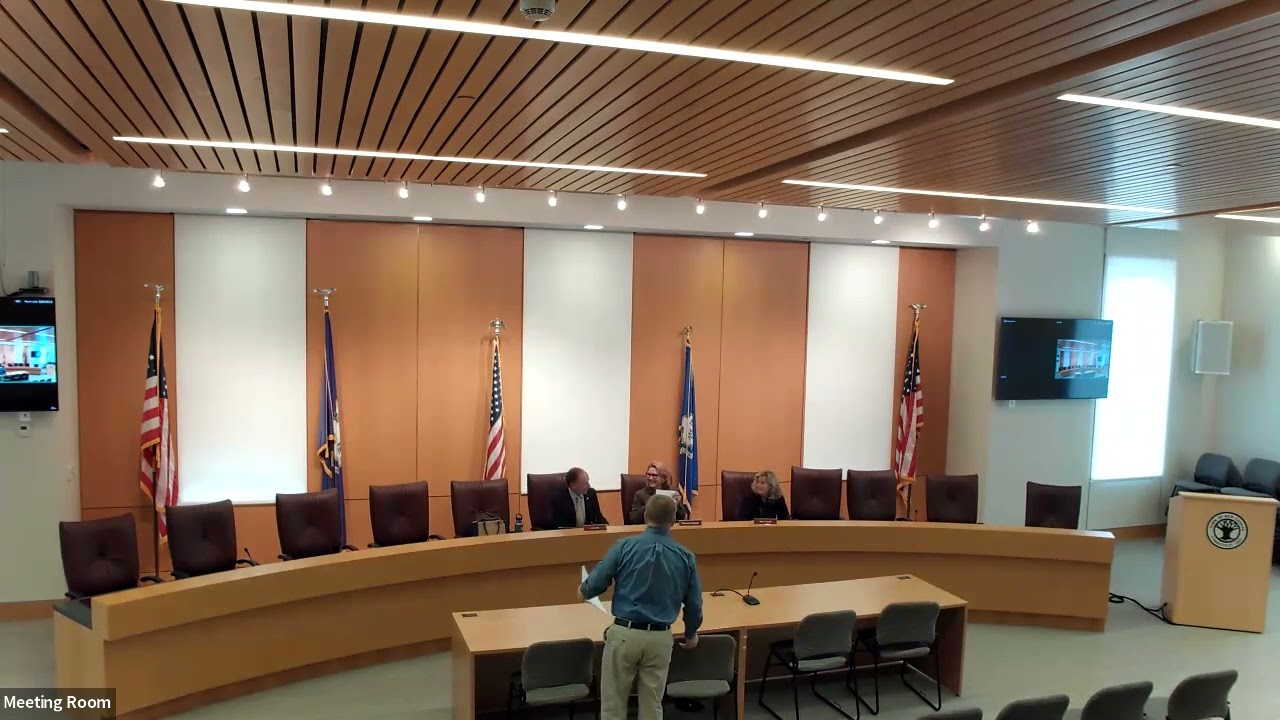
Board of Selectmen · Meeting of September 22, 2026
New Canaan Selectmen approve $142,623 in contracts for a redesigned Center School parking lot lighting project. The board awarded $97,743 to F&M Electric Supply for lampposts, $23,375 to VVV Industries for installation and $21,505 to Darien Electric for wiring, after Department of Public Works staff said tariffs on metal pushed costs above the roughly $140,000 originally budgeted. Separately, the board approved $37,550 in Fuss and O'Neill contract amendments tied to $2.3 million in potential state grant funding for Park Street sidewalks and the Farm Road intersection, plus $16,500 for a new East Avenue sidewalk grant application.
The board also renewed $126,790 in town technology contracts, approved hiring Jack Grace as IT systems administrator and Richard De Leo as a highway equipment operator, and OK'd $10,305 for new statewide voter tabulator software ahead of a December 10 system changeover. All votes were unanimous.
In the full story:
- Who Was There
- Organizations And Documents Referenced
- The complete report — 3,278 words
Source: the Board of Selectmen meeting of September 22, 2026, reported from the official video recording and transcript.
The Full Article
Agenda and Minutes
The board opened by amending its own agenda: removing an item that would have ended employee John Amarillo's probationary status because Town Clerk Claudia Weber had not submitted the necessary paperwork in time, correcting a contract price on item five to $46,019.75, and fixing a location error on item seven that had misidentified the Center School lamppost project as "Waveny Park." All amendments passed unanimously, as did approval of the September 15, 2026 meeting minutes without corrections. No members of the public came forward during the public comment period.
Information Technology Contract Renewals
Background and stakes: The town's IT department, led by Chris Kaiser, brought three routine license and service renewals before the board, all previously budgeted.
The question before the body: whether to authorize renewal contracts for cloud licensing, backup infrastructure and phone service.
Substantive content: The board approved $49,738.50 to Presidio for renewal of the town's Microsoft 365 E3 license along with Exchange Online and SharePoint, which the town uses to support its tablet fleet. Kaiser said the town is migrating fully off on-premises Microsoft infrastructure into the cloud, and that shopping the renewal around competitively saved the town roughly $57,000. Presidio holds a state contract and is a "premier license partner" with Microsoft. The board separately approved $24,985.72 to CDWG for renewal of the town's Rubrik hybrid cloud backup solution, covering fire, EMS and town hall systems; Kaiser noted the price had barely increased from the prior year. The largest of the three, $52,066.34 to Total Communications, covers year three of a three-year Cisco Collaboration Flex licensing contract for the town's Cisco phone system, which the town has used since 1999. The full three-year contract was previously approved for $156,199 combined at the board's October 21, 2025 meeting.
The deliberation: Members asked why the town had not migrated to a desk-phone-only or fully cloud-based system. Staff said police and EMS dispatch functions require the current phone infrastructure and cannot rely solely on internet-based voice service, since a network outage would otherwise eliminate all voice communication. Staff indicated the town would evaluate a hybrid phone solution before the next contract renewal cycle.
Procedural steps and outcome: All three contracts were approved by unanimous voice vote with no discernible dissent.
Implications and what is next: The Cisco contract's final year expires after this renewal, and staff signaled a hybrid-system evaluation will inform the next multi-year commitment.
Department of Public Works: Utility Vehicle Replacement
Background and stakes: The highway department's 2015 Toro Workman HDX utility vehicle, used weekly across all four seasons for tasks including sidewalk salting, has reached the end of its roughly ten-year expected service life.
The question before the body: whether to approve purchase of a replacement vehicle.
Substantive content: DPW staff requested $46,019.75 to purchase a new diesel, four-wheel-drive Workman HDX with a dump body, strobe lights and heated cab through the Sourcewell purchasing agreement, reflecting a $9,000 trade-in of the old vehicle and a 22 percent discount. A separate cab door kit added just under $3,000 to the price.
The deliberation: A board member questioned why the town chose diesel over an available electric version. DPW staff explained that winter salting operations require the vehicle to run continuously without the ability to return to a charging station, and that diesel remains more fuel-efficient in cold starts. Another member noted it would help to see photographs of comparable vehicles already in service, such as the one used by highway department staff member Walter to water downtown flower beds, before approving similar purchases in the future.
"So especially, you know, I get it, but we have to look at the other side of everybody if you lose internet too. Now you don't have any voice anywhere." — a Department of Public Works staff member
Procedural steps and outcome: Approved unanimously.
Implications and what is next: The replacement vehicle supports year-round highway operations including winter salting; the trade-in reduces net cost to the town.
Center School Parking Lot Lighting Project
Background and stakes: The existing lampposts at the Center School parking lot are old, have experienced recurring failures, and a lighting study found insufficient coverage, prompting the DPW to design a replacement and expansion of the lighting there. The project had already lost roughly a year to the installation of temporary lighting in the interim.
The question before the body: whether to award three linked contracts, covering fixture procurement, installation and electrical work, to complete the project.
Substantive content: The DPW went out to bid for the lampposts themselves; two bids were submitted, but one, from a Texas-based supplier, was disqualified for improperly sealing its submission, leaving F&M Electric Supply as the sole qualified bidder at $95,359 plus a $2,384 contingency, for a total of $97,743, covering 19 single and four twin lampposts and fixtures. For installation, the town solicited three contractors: Fluvial Construction did not submit a bid within the deadline, VVV Industries bid $21,250, and Hussey Brothers bid $48,775. The board awarded VVV Industries the installation contract at $21,250 plus a $2,125 contingency, for $23,375 total, covering removal of old units and installation of 23 new fixtures. For electrical work, Darien Electric, which staff said has extensive experience with the town's buildings, parking lots and street lights, was awarded $19,550 plus a $1,955 contingency, for $21,505 total. Combined, the three contracts total $142,623.
The deliberation: The discussion consumed roughly twenty minutes of the meeting. Several members initially assumed the new fixtures would match either the decorative "candy cane" style used at the train station or the downtown lampposts, and asked to see photographs before deciding. DPW staff clarified the Center School fixtures are a plainer, less expensive, more contemporary design chosen for functional down-lighting rather than the decorative outward-casting downtown style, in part because the lot is not adjacent to downtown and because tree cover limits fixture options. One member worried that a mismatched style could create confusion about whether the lot belongs to the town or the adjacent library.
"I don't want it to become confusing. That is a town lot and we should be making sure that we're responsible for it and people should know it's our lot." — a member of the Board of Selectmen
Staff said the new fixtures cost $3,841 for a single unit versus roughly $7,000 for the decorative downtown style, with installation bringing the per-unit cost to about $7,500, compared with $1,750 to install a downtown-style unit versus a roughly $900 installation cost on the newer style, on top of the higher base fixture cost. The town's outside lighting consultant, who assisted with the earlier Waveny House project at no cost to the town, provided the engineering behind the design and worked with multiple manufacturers to find options that met coverage needs without exceeding budget.
On installation logistics, DPW's on-site engineer said the project would reuse existing footings and conduit where possible, avoiding disruption to the grass and asphalt, though some new footings and a new junction box may be required along an expanded run near the library-facing side of the lot. Members separately asked whether the town should instead pursue a larger parking lot expansion project before investing in permanent lighting infrastructure; staff responded that a parking study completed within the last year found the lot's current capacity adequate, and that any expansion project could take several years to move from budgeting through construction. The board agreed the lighting investment functions as a reasonable near-term measure regardless of any future lot redesign, since existing footings and much of the wiring could likely be reused if an expansion eventually occurs.
Members also asked about light color temperature and control. Staff said the new LED fixtures, rated for roughly 20,000 hours of use, are set to a warm color temperature similar to lighting used elsewhere in town, following past complaints about overly bright, "hospital"-style lighting installed at other town facilities. The fixtures are controlled by astronomical timers that adjust automatically to sunrise and sunset based on latitude and longitude, and remain on throughout the night for security purposes; shields can be adjusted to prevent light spillage onto neighboring properties, coordinated with the Planning and Zoning department.
On cost, staff acknowledged the project came in higher than the roughly $140,000 originally budgeted, attributing part of the increase to tariffs on imported metal, and said DPW would transfer approximately $30,000 in unused funds from a separate, already-completed capital project to cover the shortfall rather than request new appropriation.
"They did, you know, twenty, thirty percent, nothing surprises us anymore, does it, when it comes into anything to do with metals or whatever." — a Department of Public Works official
Procedural steps and outcome: All three contracts, F&M Electric Supply, VVV Industries and Darien Electric, were approved by separate unanimous votes.
Implications and what is next: DPW staff said they intend to complete footing and conduit work before winter, with new poles installed once they arrive from the manufacturer, which staff said could take several months. The department will coordinate construction scheduling with the adjacent library to minimize disruption.
Registrar of Voters: Election Tabulator Software
Background and stakes: Connecticut's Secretary of State, working with the University of Connecticut, selects the tabulator software municipalities must use, leaving individual towns with no discretion over vendor selection.
The question before the body: whether to approve a purchase order for updated tabulator software and licensing.
Substantive content: The board approved $10,305 to Electric Election Systems and Software LLC. The Registrar of Voters' office, presented by a staff member identified as Liz, said New Canaan maintains DS300 tabulators and is required to have a working tabulator for each of its six voting districts, including one small district created after redistricting, plus backup units for early and absentee voting; the town currently maintains 17 tabulators including backups. Liz said the bulk of the cost reflects a warranty extension through June 2027 rather than new equipment. A statewide transition to new voter tabulation software is scheduled to take effect December 10, 2026, after having been postponed multiple times; election officials plan to train on the new system this week.
The deliberation: A board member asked whether tabulator costs vary significantly among towns of different sizes; the presenter said she did not have a direct comparison but noted New Canaan's redistricting left it with more districts, and thus more required tabulators, than some towns of similar size.
Procedural steps and outcome: Approved unanimously.
Implications and what is next: New Canaan's voter tabulation system will change statewide in December, ahead of future elections; the town's backup tabulator, used at the recent primary after a sealing malfunction disabled a primary unit, will remain part of its redundancy plan.
Fuss and O'Neill Contract Amendments: Park Street, Farm Road and School Zone Permits
Background and stakes: The town has three active applications moving through state and regional review, a Park Street sidewalk LOTCIP application, a Farm Road intersection LOTCIP application, and a school zone encroachment permit dating to 2023 that required repeated rounds of review by the state Office of State Traffic Administration.
The question before the body: whether to approve additional engineering fees to Fuss and O'Neill to respond to rounds of state and regional agency comments needed to keep the applications moving.
Substantive content: The board approved $34,150 plus a $3,400 contingency, for $37,550 total, covering a $20,500 amendment to the Park Street LOTCIP documentation contract (originally signed January 8, 2026), a $6,700 amendment to the Farm Road LOTCIP application contract (originally signed August 4, 2025), and a $6,950 amendment to the school zone encroachment permit contract (originally signed December 13, 2023, with commission approval received the prior week). Staff said the three applications collectively could bring $2.3 million to the town if successful, including $1.5 million for the Farm Road intersection and roughly $800,000 for Park Street sidewalks.
The deliberation: Staff described the added costs as driven mainly by the volume of back-and-forth review meetings with state agencies rather than design changes, and praised Fuss and O'Neill's relationship with state agencies as a factor in moving the applications forward.
Procedural steps and outcome: Approved unanimously.
Implications and what is next: The applications continue moving through state and regional review; approval of the underlying grant funding is a separate future step.
East Avenue (Route 106) Sidewalk Grant Application
Background and stakes: The existing asphalt sidewalks along East Avenue, spanning from Main Street to New Norwalk Road, are deteriorating, with a gap in continuous sidewalk on the southern side between Summer Street and Millport Avenue that residents have specifically requested be addressed.
The question before the body: whether to fund preparation of a Western Council of Governments (West Cog) Local Transportation Capital Improvement Program (LOTCIP) grant application for the sidewalk project.
Substantive content: The board approved $16,500 to Fuss and O'Neill to prepare the LOTCIP solicitation submission, covering mapping, cost estimates and coordination with the design engineer of record. West Cog opens its next LOTCIP funding round on September 25, with applications due November 12; if endorsed by West Cog and its technical advisory group, the town would proceed to a full program application under Connecticut Department of Transportation requirements. Staff estimated the underlying construction project at roughly $1 million and said total engineering and design costs, including surveying work by the engineering firm DeAngelis, would likely run close to 10 percent of construction cost, or roughly $100,000 combined.
The deliberation: A board member asked whether the town would pursue the sidewalk repair regardless of grant success, given that other LOTCIP-funded projects have been framed as opportunistic; staff said East Avenue sidewalks need reconstruction regardless of the grant outcome, making the LOTCIP application a genuine cost-offset opportunity rather than a discretionary add-on. A member also raised the need to update town ordinance to clarify sidewalk maintenance responsibility along the corridor.
Procedural steps and outcome: Approved unanimously.
Implications and what is next: The town will submit its LOTCIP solicitation by November 12; DPW staff will separately evaluate the feasibility of closing the sidewalk gap between Summer Street and Millport Avenue.
Department of Public Works Project Updates
DPW staff briefed the board on several active construction projects. Building envelope work began this week at the Lapham Community Center, with staff coordinating disruption mitigation with facility staff identified as Kathy. Route 124 paving has narrowed traffic to a single southbound lane from Lambert Road into town, with the top paving course expected by Wednesday or Thursday, weather permitting. Paving on Route 106 from the Wilton town line to Canoe Hill Road is scheduled to begin the following Monday and is expected to take four to six weeks; drivers were asked to avoid that stretch during work hours. Separately, staff highlighted ongoing beautification plantings at Irwin Park, including a delivery of new trees this week.
Personnel: Two New Hires
The board approved hiring Jack Grace as information technology systems administrator, effective October 5, 2026. Human resources staff, presented by a department representative identified as Cheryl, said Grace was one of 48 applicants for the position; the department conducted six first-round interviews and two second-round interviews. Grace currently serves as network administrator for the town of Bethel after previously working as an IT specialist there, holds a bachelor's degree in business administration in cybersecurity from Western Connecticut State University, and is a U.S. Air Force veteran. IT's Chris Kaiser said Grace "meets and exceeds the criteria we were looking for" and that municipal government experience, which was difficult to find in candidates, made him a strong fit.
The board also approved hiring Richard De Leo as equipment operator II in the highway department, effective October 5, 2026. De Leo was one of 58 applicants; the department set up nine interviews and ultimately interviewed six candidates. He brings masonry, plowing and landscaping experience and will work toward a commercial driver's license within a year of hire, a credential a highway department staff member identified as Lou said the department has had difficulty finding in outside applicants.
Both hires were approved unanimously.
Parking Department Conference Travel
The board approved a request from the Parking Department for one staff member, identified as Kevin, to attend the 2026 New England Parking and Transportation Council conference and trade show in Providence, Rhode Island, September 28 through 30, at a cost not to exceed $1,000. Staff said the town is not a member of the organization and learned of the conference only the prior week through a vendor presentation, and that training funds were identified to cover the cost. The request was approved unanimously.
Board or committee members present: not individually named in the available transcript; the board conducted business by voice vote throughout with no roll call recorded. Town Clerk Claudia Weber — referenced in connection with a delayed probationary-status paperwork item; attendance not confirmed in transcript. Chris Kaiser, information technology — presented three IT contract renewals and commented on the Jack Grace hire. A Department of Public Works staff member identified as Bill — addressed technical questions on the Center School lighting installation. A Department of Public Works staff member identified as Ryan — presented the utility vehicle replacement request alongside a colleague identified only as John. A Registrar of Voters staff member identified as Liz — presented the tabulator software purchase order. A Human Resources department representative identified as Cheryl — presented both personnel hiring requests. A Highway Department staff member identified as Lou — attended the Richard De Leo hiring discussion. A Parking Department staff member identified as Kevin — requested conference travel approval.
Public commenters: none; no members of the public addressed the board.
Outside parties: Jack Grace and Richard De Leo, job candidates presented for board approval as new town hires.
Presidio — Microsoft licensing partner awarded the town's E3/Exchange/SharePoint renewal contract. CDWG — vendor awarded the town's Rubrik cloud backup renewal contract. Total Communications — vendor awarded the town's Cisco phone system licensing renewal, year three of three. Turf Products Corp. — vendor awarded the new highway department utility vehicle purchase under a Sourcewell purchasing agreement. F&M Electric Supply — sole qualified bidder awarded the Center School lamppost fixture procurement contract. VVV Industries — contractor awarded installation of the Center School lampposts. Darien Electric — contractor awarded electrical work for the Center School lampposts. Hussey Brothers and Fluvial Construction — competing bidders on the Center School lamppost installation contract; Fluvial did not submit a bid in time, Hussey Brothers' bid was not selected. Electric Election Systems and Software LLC — vendor awarded the town's tabulator software purchase order. Fuss and O'Neill — engineering firm awarded amended contracts for the Park Street, Farm Road and school zone LOTCIP-related applications, and a new contract for the East Avenue sidewalk grant application. DeAngelis — engineering firm cited as providing surveying services for the East Avenue sidewalk project. Western Council of Governments (West Cog) — regional body administering the LOTCIP grant program the town is applying to for the East Avenue sidewalk project; its technical advisory group (TAG) must endorse applications before state submission. Connecticut Department of Transportation — administers the state-level LOTCIP program requirements referenced for the East Avenue application. Connecticut Office of State Traffic Administration — state agency cited in connection with the school zone encroachment permit review. Connecticut Secretary of State and University of Connecticut — cited as jointly selecting the statewide voter tabulator software platform municipalities must use. Town of Bethel — Jack Grace's current municipal employer, cited in his hiring presentation. Western Connecticut State University — cited as the source of Jack Grace's bachelor's degree in cybersecurity.