Wetlands panel approves Turtleback Lane erosion fix
The New Canaan Inland Wetlands Commission approved a stream armoring and sediment-control permit for a Turtleback Lane West property.
Inland Wetlands · Meeting of October 19, 2026
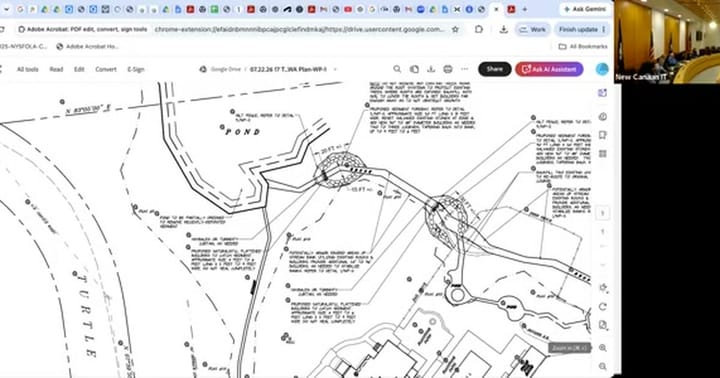
NEW CANAAN — The New Canaan Inland Wetlands Commission approved a stream armoring and sediment-control permit for a Turtleback Lane West property. Chaired by Angela Jameson, the commission voted unanimously for application 26-18 after consultant Matt Boat explained erosion had redeposited sediment into a pond just months after a 2025 town-permitted dredging. Two new 20-by-15-foot sediment forebays and stone bank armoring are planned, with a site visit for two other pending applications set for November 4 at 7:30 a.m.
Staff member Kathleen Hall also updated the board on a stalled North Wilton Road tree-clearing enforcement case and told members state law caps wetlands fines at "$500 in the upland review area... and $1,000 if there's a violation in wetlands," prompting debate over whether penalties deter repeat violators.
In the full story:
- Who Was There
- Organizations And Documents Referenced
- The complete report — 2,222 words
Source: the Inland Wetlands meeting of October 19, 2026, reported from the official video recording and transcript.
Checked against the record: before publication this article was automatically compared with the meeting transcript.
The Full Article
Call to Order, Roll Call and Routine Approvals
Chair Angela Jameson opened the October 19 meeting at 7 p.m. with members and staff present both in Town Hall and on Zoom. The secretary's roll call named ten individuals associated with the commission: Jameson, Sandy Redmond, Beth Bernali, Don Mastronardi, Beth Samford (called "Sanford" on the roll but corrected to "Samford" later in the meeting), Dan Stepanek, Bill Williams, Tom Collingham, Katie Owsley and Adam Ramirez. Jameson noted three regular members were absent and asked Collingham and Owsley, evidently alternates, to sit in for the meeting. The agenda was approved unanimously on a voice vote. Minutes of the September 14, 2026 regular meeting and the October 14, 2026 site visit were each approved separately, with one member abstaining from each vote after saying she had not attended the respective meeting. None of this consumed more than a few minutes and none drew substantive discussion.
New Applications Received and Site Visit Scheduling
Two new applications were read into the record for intake only, with no deliberation: application 26-23, filed by Patricia L.R. and Gordon B. Fowler Jr., proposing hydraulic dredging of sediment from a portion of an existing pond (the street name was given in the recording in a form that could not be confirmed against a written source); and application 26-24, filed by Nadine and Luke W. Mekas, proposing mitigation and planting to correct unauthorized grading and tree and vegetation removal from a regulated wetlands area, along with installation of a boardwalk and path system (the street name likewise could not be confirmed). Both applications were slated for the November 16, 2026 regular meeting pending completeness review. The commission set a joint site visit for Wednesday, November 4, 2026, at 7:30 a.m., after a brief exchange about daylight conditions at that hour; members present, including Katie Owsley, confirmed their availability.
Application 26-18: Stream Armoring and Sediment Forebays on Turtleback Lane West
Background and stakes: The commission permitted partial hydraulic dredging of a pond on this property in 2025. By that summer, new sediment had already accumulated in the dredged area, prompting further investigation that identified active bank erosion along an upstream brook as the ongoing source.
The question before the body: Whether to approve a new permit authorizing stream bank armoring, construction of two sediment forebays, and limited supplemental dredging to address the erosion problem the 2025 project did not anticipate.
Substantive content: Matt Boat, presenting for the property owners, described a two-part fix. First, stream banks would be armored with existing stone and imported boulders along the stretch from where the brook meets the ponds up to the property line. Second, two forebays, each 20 feet by 15 feet, would be excavated to catch sediment before it reaches the ponds: a larger, upstream forebay at a natural widening of the channel, and a second, deeper forebay closer to the pond where the stream cuts more steeply. Limited dredging would follow, using a hydraulic pump into a dewatering tube staged on an existing path, with no new ground disturbance required for that step. Boat said the 2025 dredging reached depths as great as five and a half feet in places and removed years of accumulated sediment, but that the broader pond, roughly five times the size of the dredged area, still carries a heavy nutrient load contributing to duckweed and algae growth the current project does not address.
The deliberation: Commissioners focused on practical and process questions rather than the design itself. One member asked whether planting could serve as an alternative to armoring; Boat said the brook's intermittent but high-velocity flow made that approach insufficient on its own. Another member, addressed in the transcript as Mr. Williams, and a second identified as Mr. Collingham, asked how the work would be staged, what equipment would be used, and who would ultimately perform it. Boat said a mini excavator would access the site by truck along a rear entrance off Turtleback Lane and that a contractor had not yet been selected; he said the town's standard compliance form would require the owners to report the contractor's identity and start date once chosen. Staff, identified in the meeting as Kathleen Hall, told the commission in her staff report that "the plan as provided between the landscape architect and that office really is very complete," and that she could not identify a special condition that would improve on it. Hall also noted in response to a follow-up question that no herbicide treatment is proposed for the ornamental ponds, and that such treatment would fall under the state Department of Energy and Environmental Protection's permitting authority, not the commission's.
"The property owner is fairly new at this location, so I don't think this unraveling of the watercourse was known to be a problem until post-dredging," Hall said, noting that the erosion became apparent roughly six months after the 2025 work when the homeowner flagged new deposits.
Procedural steps and outcome: A commissioner moved to approve the application; the motion carried on a voice vote with no stated objections or abstentions. No special conditions were attached beyond conformance with the submitted plan.
Implications and what is next: The permit allows work to proceed on the stream banks and forebays without a further commission hearing; staff indicated the project will be checked for conformance with the approved plan once completed, with no long-term monitoring requirement attached.
Agent's Report: North Wilton Road Enforcement Case
Background and stakes: The commission has been tracking unauthorized tree clearing discovered on land associated with 531 and 533 North Wilton Road, tied to an entity identified as High Point New Canaan LLC, since at least the prior month's meeting.
The question before the body: Whether the applicant's team has made adequate progress toward stabilizing the site and moving toward a permit application, and whether site conditions have improved.
Substantive content: Hall reported that over the past month the property owner's engineering team has documented all tree debris piles, logging piles, limits of disturbance, wetlands boundaries and silt fence locations, and that mapping has been submitted to staff for review of where permanent silt fences and temporary stabilization measures should go. She said the state Office of the State Soil Scientist, reached through what staff called Bill Penny's office, visited the site and issued a written report. Hall said she personally visited the site again the Friday before the meeting, after a period of heavy rain, and found that runoff reaching a nearby reservoir was running "clean and clear," with no evidence of soil tracking onto the road, and that associated fines, including some planning and zoning fines, had been paid.
The deliberation: Hall expressed frustration that despite the documentation effort, she has not been able to secure an in-person meeting with the applicant's team and consultants to finalize next steps, citing scheduling gaps on their side. A commissioner asked what the next step would be if an in-office meeting cannot be scheduled; Hall said she did not have an answer but was confident one would eventually be arranged, noting the site itself remains essentially shut down with no active work occurring.
Procedural steps and outcome: No vote was taken; this was an informational update. Hall said she hoped to return in November with either a permit application or further updates.
Implications and what is next: The case remains open, with the reservoir watershed showing no current signs of active contamination, but with no firm date yet for the in-person coordination meeting staff say is needed to move the matter toward resolution.
Other Agent's Report Items
Hall briefly described several additional, non-controversial items under staff review: an administrative permit for renovation of a swing set at South School, within the 50-foot wetlands review area; a planting and restoration project on a large parcel on Adams Lane; an administrative permit for 34 Richmond Hill Road, where a collapsed footing drain beneath a set of four linked townhouses, roughly 20 years old, required excavation within the wetlands review area to stop water backing up into a unit; and a cleanup at a Bradley/Greenley-area property to remove old lighting and water features, also within the review area. None drew commission questions beyond brief clarification, and no votes were required.
Discussion of Wetlands Violation Fines
Background and stakes: Commission members had previously asked staff whether the town's wetlands fines are substantial enough to deter violations, following up on an earlier discussion connected to a charter review.
The question before the body: Whether New Canaan's fine structure is adequate, how it compares with peer towns, and whether to pursue a change through the state legislature.
Substantive content: Hall told the commission the fine amounts are fixed by state statute at $500 for a violation in the upland review area and $1,000 for a violation in a regulated wetlands area, and that amending those caps would require state legislative action. She said she surveyed a regional group of wetlands offices, including Fairfield, Darien, Greenwich, Stamford, Westport, Norwalk and Stratford, and found they operate under the same statutory limits. She noted New Canaan is unusual in also imposing a triple application fee atop any fine, and that she had asked peer towns whether they would support a legislative push ahead of the January session to raise the caps, though she said she doubts that effort will materialize. She said the ordinance directs any collected fines into the town's general fund rather than toward specific remediation, which she said is intentional to avoid creating an incentive for the enforcement office to fine for revenue.
The deliberation: Commissioners debated whether $500 to $1,000 fines meaningfully deter violations. One member argued that for large property owners who should understand the rules, the fines are a minor cost of doing business, while a smaller fine might be appropriate for a first-time homeowner violation; several suggested escalating penalties for repeat or "serial" violators rather than raising the baseline fine across the board. Another member cautioned against setting fines so high that they amount to disproportionate punishment for an inadvertent, first-time mistake, while a different member noted that the triple application fee functions as an additional deterrent beyond the base fine. Hall noted that fine issuance has tapered since the early years after the commission gained fining authority, which she characterized as a sign the current approach "may be making some headway," while acknowledging some violators will always act on their own terms.
Procedural steps and outcome: No vote or formal action was taken. Jameson said the commission would gather more information, including replies from other towns' wetlands offices, and revisit the topic at a future meeting.
Implications and what is next: Any change to the maximum fine would require action by state legislators, not the local commission; staff indicated she would circulate responses from peer towns' enforcement offices before the next substantive discussion.
Adjournment
A member moved to adjourn; the motion carried on a voice vote with no formal second recorded in the meeting audio.
Angela Jameson, Chair, present Sandy Redmond, member, present Beth Bernali, member, present Don Mastronardi, member, present Beth Samford, member, present (abstained from one minutes vote, citing absence from that meeting) Dan Stepanek, member, present Bill Williams, member, present Tom Collingham, seated as alternate for an absent regular member Katie Owsley, seated as alternate for an absent regular member Adam Ramirez, member, present Three regular members were noted as absent; their names were not stated in the recording. Kathleen Hall, town staff, delivered the staff and agent's reports Sarah, Town Planner (surname not given in available sources), referenced as having jointly investigated the North Wilton Road site with Hall Matt Boat, consultant representing the Turtleback Lane West property owners for application 26-18 Property owners of 17 Turtleback Lane West, identified in the application as Wiley and Lauren Sher, did not speak directly in the recording Patricia L.R. Fowler and Gordon B. Fowler Jr., applicants for application 26-23, not present to speak Nadine Mekas and Luke W. Mekas, applicants for application 26-24, not present to speak
Connecticut state statute governing wetlands fines — cited by Kathleen Hall as capping local penalties at $500 for upland review area violations and $1,000 for wetlands violations, and as requiring state legislative action to change. Regional group of municipal wetlands offices (Fairfield, Darien, Greenwich, Stamford, Westport, Norwalk, Stratford) — surveyed by Hall on fine practices and potential legislative advocacy. Office of the State Soil Scientist, referenced in the meeting as "Bill Penny's office" — visited the North Wilton Road site and issued a written findings report. High Point New Canaan LLC — entity associated with the property at 531 and 533 North Wilton Road, subject of the ongoing tree-clearing enforcement case. September 14, 2026 regular meeting minutes — approved with one abstention. October 14, 2026 site visit minutes — approved with one abstention. Application 26-18 — permit for stream armoring, sediment forebays and limited dredging at the Turtleback Lane West property, approved at this meeting. Applications 26-23 and 26-24 — new applications received, site visit scheduled for November 4, 2026; tentatively on the November 16, 2026 regular meeting agenda. 2025 dredging permit — prior commission approval cited as the origin of the erosion problem addressed by application 26-18.
Share this story
Know someone in New who follows town government? Share Townbrief New: they can sign up free.