Commission Hears DOT Rejections On Route 123 Fixes
The New Canaan Police Commission heard renewed pleas to fix dangerous speeding on Route 123 after years of state denials.
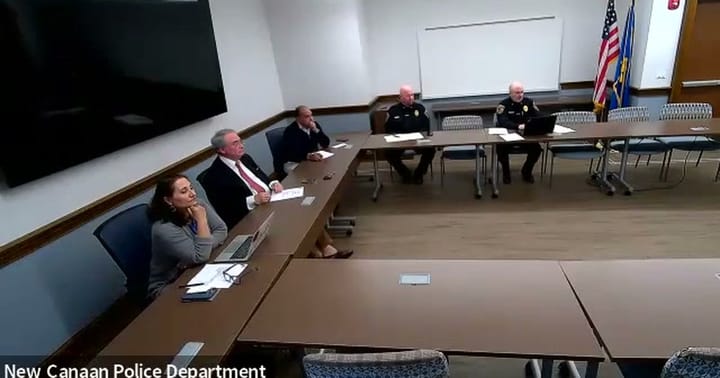
Other Committee · Meeting of October 21, 2026
NEW CANAAN — The New Canaan Police Commission heard renewed pleas to fix dangerous speeding on Route 123 after years of state denials. State Rep. Tom, of the 125th House District, and town council member Chris told commissioners the Connecticut Department of Transportation has rejected requests to lower the corridor's speed limit to a uniform 40 miles per hour and to eliminate passing zones near residential driveways.
The police chief said the DOT also refused years of requests to improve the Canoe Hill, Carter Street and Route 106 intersection. "If you look at the accident record, it is terrible. There are constantly accidents there," Chris said.
The chief said speeds on Route 123 routinely run "40, 50-plus miles an hour" and that the department will keep rotating portable speed-feedback trailers through the corridor while Tom follows up with his own DOT contact. The commission separately approved, on unanimous voice votes, September minutes, two officer education reimbursements, an invoice package and its 2027 meeting calendar.
In the full story:
- Who Was There
- Organizations And Documents Referenced
- The complete report — 1,807 words
Source: the Other Committee meeting of October 21, 2026, reported from the official video recording and transcript.
Checked against the record: before publication this article was automatically compared with the meeting transcript.
The Full Article
State Representative And Councilman Press For Route 123 Fixes
The Connecticut Department of Transportation has repeatedly rejected New Canaan's efforts to make Route 123 safer, setting up a renewed round of advocacy at the October 21 Police Commission meeting. A state representative and a town council member, both identified in the meeting only by their first names, Tom and Chris, appeared as visitors at the top of the agenda to press the commission on what more could be done about speeding and accidents along the corridor, particularly near its intersections with Michigan Road and with Carter Street and Route 106 at Canoe Hill.
The question before the commission was narrow but consequential: beyond the traffic-engineering requests already pending with the state, what additional tools, policies or advocacy could reduce speeding on Route 123 and prevent what Chris described as inevitable serious accidents.
The police chief laid out the department's track record with the DOT in detail. Roughly a decade ago, the chief and a colleague referred to only as Tiger developed a sight-line improvement plan for the Route 123 and Michigan Road intersection, which the DOT approved on the condition that the town fund and perform the work itself. The town did so, clearing vegetation and removing ledge that obstructed driver sightlines. More recently, the commission petitioned the DOT to lower Route 123's speed limit to a uniform 40 miles per hour, since posted limits currently run 45 mph at the corridor's north and south ends and drop to 40 in the middle. The DOT took more than a year to review that request, conducted an unannounced site visit, and denied it. A separate petition to eliminate passing zones on Route 123 and 124 was also denied; DOT staff told the commission there was insufficient accident data to justify removing the lanes and argued the change could increase speeds as drivers continued to pass without a formal lane. The commission said the DOT also declined, over a period of years, to make any changes at the Canoe Hill, Carter Street and Route 106 intersection.
Tom, who said he represents the 125th House District in the state legislature, told the commission he had reached out to his own DOT contact that day and had not yet heard back, after learning the chief had already exhausted the commission's own channel. He used the opening to raise a broader concern about active policing, tracing police reluctance to aggressive traffic enforcement to the state's 2020 police accountability law, which he said narrowed qualified immunity protections for officers until after trial. "If I were advising officers now, err on the side of caution and don't put yourself out there if you don't have to," he said, describing his own evolution toward reconsidering speed cameras as an alternative enforcement tool.
Chris, who described himself as a longtime member of the town council though he said he does not live near the corridor, argued for a permanent traffic signal rather than additional flashing warning signs at Michigan Road and Route 123. He cited the corridor's accident history and recalled a decades-earlier, multiyear campaign for a signal at Route 123 and Carter Street, during which he said town advocates were told in writing that "there had not been enough deaths to mandate a light." Chris offered to supply the chief with names and addresses of residents who have contacted him about the issue.
"If you look at the accident record, it is terrible. There are constantly accidents there," Chris said. The chief did not dispute the characterization, telling the visitors "it is a state road, it is heavily traveled, it's a cut-through, it's a main thoroughfare, and the speeds are routinely 40, 50-plus miles an hour."
No vote was taken on the traffic items; the discussion was advisory and informational. The chief outlined steps already underway or under consideration: deploying three or four portable, battery- or solar-powered speed-feedback trailers on a rotating basis to slow traffic and collect data on speed, volume and time of day; consulting again with Tiger about reactivating motion-activated flashing red lights at the Michigan Road stop signs, technology the chief said has improved since the idea was shelved years ago over neighbor concerns; and continuing routine selective traffic enforcement, which the chief said temporarily slows drivers who see a patrol car but does not produce a lasting effect. Tom committed to following up with his DOT contact and reporting back to the commission once he received a response, saying, "The ball's in my court with the state DOT, and I promise you I will do my best." The chief thanked both visitors at the close of the exchange.
The implication for residents is that no new state action on Route 123 is imminent. The commission's recourse remains incremental: data collection via the trailers, a possible revival of flashing signage at Michigan Road, and whatever leverage Tom's legislative contact with the DOT can generate. No date was set for a follow-up report.
Routine Business: Minutes, Reimbursements, Calendar
The commission handled several administrative items without discussion or dispute, each approved on a unanimous voice vote: the minutes of the September 16 regular meeting; a college course reimbursement for Sergeant Lopez, whose coursework the commission noted covers cyber threats, intelligence and financial crimes, described by one commissioner as "something that's getting worse and expanding"; a reimbursement for an officer identified only as Nicole, who is pursuing a master's degree in forensic accounting; a package of invoices and employee reimbursements, which a commissioner said had been reviewed for compliance with contract terms; and the proposed 2027 commission meeting calendar. None of these items drew questions from commission members present.
Letters Of Appreciation
The chief read a series of commendation letters into the record, a recurring agenda item he and commission members described as one of the more rewarding parts of the meeting. Officer Maru Castro, the South School resource officer, was thanked along with colleagues named as assisting with a fourth-grade class visit of roughly 44 students, including officers identified as Nicole Bartulli, Kelly Caughlin, Shannon Gibson, Matt Blank and Tom Calinan. Officer Hamilton was commended for locating and returning a phone lost at a town concert. Sergeant Oaks forwarded a commendation for Officer Mori's handling of a vehicle stop involving young children, which a parent described as calm and attentive. Officer Austin Chenzi was thanked for his professionalism responding to a medical emergency. Sergeant Caponera relayed a resident's gratitude after Officer Christopher Rodriguez helped arrange a tow for a disabled vehicle and notified the parking department so the resident would not receive a ticket.
One commissioner remarked that such small acts of individual service build community trust in ways that formal community-policing programs cannot replicate on their own, saying residents are affected "by how they make you feel in the moment."
Chief's Monthly Report: Staffing, Statistics And Budget
The chief reported the department is operating at approximately 70 percent minimum-shift staffing, with a few officers out on long-term injury recovery and new recruits still working through the police academy, a process he said takes roughly six months before new officers are fully deployed. He said the department currently has one vacancy, with an additional retirement expected in January and a possible third in May, and that interviews for open positions are tentatively planned for December.
On monthly statistics, the chief said motor vehicle enforcement and location checks continue trending upward, and that officers have increased visible foot patrols downtown, particularly during evening shifts, which he said residents and business owners have noticed. He said stolen vehicle incidents remain elevated and that the department continues to coordinate with a regional stolen vehicle task force.
On the budget, the chief said the department is operating at about 40 percent of its current fiscal year budget and remains on track. He said the department does not anticipate major capital purchases beyond three vehicle replacements this year and no large weapons or equipment purchases, calling the operating budget "pretty tight, pretty thin." He said a draft budget for fiscal year 2026-27 would be ready by early November, ahead of presentations to the first selectman, Board of Selectmen, Board of Finance and town council early next year.
The commission's presiding officer and voting members were not individually named in the available meeting audio; motions were made, seconded and approved without members being identified by name on the recording. Editors should confirm the commission's roster separately, as no roster block was supplied for this meeting.
Police Chief — presented the DOT traffic history, staffing report, monthly statistics and budget update; name not stated in the transcript.
State Rep. Tom — Connecticut House of Representatives, 125th District; appeared as a visitor to press for state action on Route 123 speeding; surname not given in the transcript.
Chris — identified as a New Canaan town council member; appeared as a visitor alongside Tom to advocate for a traffic signal on Route 123; surname not given in the transcript.
Tiger — referenced by the chief as a longtime collaborator on Route 123 and Michigan Road traffic-engineering work; role or department affiliation not stated.
Sergeant Lopez — subject of an approved college course reimbursement for coursework in cyber threats, intelligence and financial crimes.
Officer Nicole — subject of an approved reimbursement for a master's degree in forensic accounting; surname not confirmed.
Officers and supervisors cited in letters of appreciation: Maru Castro, Nicole Bartulli, Kelly Caughlin, Shannon Gibson, Matt Blank, Tom Calinan, Hamilton, Mori, Sergeant Oaks, Austin Chenzi, Sergeant Caponera, Christopher Rodriguez.
Connecticut Department of Transportation — the state agency with authority over Route 123 and 124 speed limits, passing zones and intersection design; denied the commission's requests to lower the speed limit to 40 mph uniformly and to eliminate passing zones, and has not acted on long-pending requests at the Canoe Hill, Carter Street and Route 106 intersection.
Connecticut General Assembly, 125th House District — represented by Tom, who raised the issue on behalf of constituents and committed to following up with his DOT contact.
New Canaan Town Council — represented by Chris, who advocated for a traffic signal and offered to supply the chief with names of concerned residents.
Connecticut's 2020 police accountability law — cited by Tom in discussing the narrowing of qualified immunity protections for officers and his resulting shift toward supporting speed cameras as an enforcement alternative.
September 16 meeting minutes — approved without changes at the start of the commission's regular business.
2027 meeting calendar — approved as proposed for the commission's upcoming meeting schedule.
Draft fiscal year 2026-27 police department budget — described by the chief as due by early November, ahead of review by the first selectman, Board of Selectmen, Board of Finance and town council.
Share this story
Know someone in New who follows town government? Share Townbrief New: they can sign up free.