Housing panel debates paths to 2032 moratorium
New Canaan's Affordable Housing Committee spent its October 19 meeting line-editing a draft 2032 housing strategy report rather than voting on any findings. Five members, including Bob Strong and Chris Wilson, formed a quorum and unanimously approved minutes from two prior meetings.
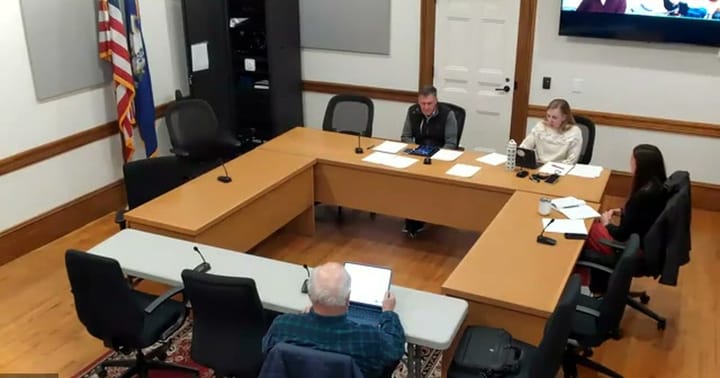
Other Committee · Meeting of October 19, 2026
New Canaan's Affordable Housing Committee spent its October 19 meeting line-editing a draft 2032 housing strategy report rather than voting on any findings. Five members, including Bob Strong and Chris Wilson, formed a quorum and unanimously approved minutes from two prior meetings. Much of the session focused on competing paths to a 2032 moratorium under state 8-30g law: a years-long Lumberyard master-planning process, converting dozens of Riverwood Apartments units, or a hybrid.
Members calculated that converting units at Riverwood to reach 40 percent affordability would yield just 31.5 of the roughly 151.5 points needed, "which leave the 120 on the table to come," one member said. Another called the situation one with "no simple slam dunk solution for 2032." The committee flagged legal risk around re-imposing Riverwood deed restrictions, citing attorney Tim Hollister's past arguments against the town, and agreed to consult housing consultant Sarah Carey before finalizing scenarios.
In the full story:
- Who Was There
- Organizations And Documents Referenced
- The complete report — 2,077 words
Source: the Other Committee meeting of October 19, 2026, reported from the official video recording and transcript.
Checked against the record: before publication this article was automatically compared with the meeting transcript.
The Full Article
Roll Call and Minutes
Five members formed a quorum at the October 19 meeting: Bob Strong, Michael Sweeney, Jeff Williams, Jane Williams and Chris Wilson. Maria Weingarten was absent; Bill Perrette's presence was not confirmed at roll call. The committee approved minutes from its August 10 and September 14, 2026 meetings on a motion by Strong, seconded by a member identified only as Hillary, with no recorded opposition. Both the project subcommittee and finance subcommittee reported they had not met since the prior session.
Report Review: Background, Policy Context and 8-30g Framework
Background and stakes: The committee is assembling a report, titled in draft as "Affordable Housing Options: Recommendations for 2032," intended to inform the Board of Selectmen and Town Council as the town considers its next move under Connecticut's 8-30g affordable-housing appeals statute. New Canaan has pursued successive moratoriums rather than crossing the 10 percent affordable-housing threshold outright, a strategy members said no other Connecticut town has replicated.
The question before the body: Members were reviewing draft language, not voting on findings, working through the document page by page to flag wording, sourcing and substantive gaps before a further round of edits.
Substantive content: The draft states that under 8-30g, the burden of proof shifts so that "the municipality must justify its decision under the standards established in 830G," rather than the developer proving compliance with local zoning. Members noted the draft should add that "towns generally lose in court" under that framework. A comparison section describes how nearby towns have approached 8-30g differently: Darien has effectively accepted 8-30g development near Interstate 95 and Route 1; Westport, in the committee's assessment, "doesn't really have a coherent strategy"; and Greenwich runs an affordable housing trust, funded with federal pandemic relief money, that invests $50,000 to $100,000 in subordinate debt into developers' projects in exchange for smaller-scale, town-negotiated developments where units at 80 percent of area median income count toward the town's affordable total. One member noted New Canaan sits in "this Goldilocks state" of high land values and a housing stock of roughly 7,500 units, small enough that developers can meaningfully move the percentage, unlike Greenwich, which the member said "could never build enough every four years" to qualify for a moratorium given its larger stock.
The deliberation: Discussion also touched on funding mechanisms cited in the draft, including project debt generally from the Connecticut Housing Finance Authority, the town's housing trust fund, and Low-Income Housing Tax Credit proceeds. One member raised concern that the report references "combinations of these funding sources" without explaining what they are, worrying that readers might assume "we're going to build a hundred million dollars and it ... is going to come direct from taxpayers." Members agreed to consider an appendix or endnote explaining the financing structure and to revisit how 60 percent and 80 percent of area median income are defined earlier in the document, potentially importing a graphic from a prior committee presentation.
Procedural steps and outcome: No vote was taken; the committee agreed informally to draft additional explanatory language and endnotes for recirculation.
Report Review: Moratorium History and Past Litigation
Background and stakes: The draft recounts the town's moratorium history, including a lawsuit against the state Department of Housing and an 8-30g acquisition application at 51 Main Street, the former Red Cross building, received during a gap between moratoriums.
Substantive content: Members corrected a passage describing two prior case outcomes, agreeing it should read that "the court overturned the denials and approved the projects," replacing passive phrasing. On the Department of Housing litigation, one member explained the case "never went to trial" because "the law was clarified" by the legislature while the matter was pending, establishing that the state's intent differed from the Department of Housing's prior interpretation, which obviated the need for a ruling. Members debated whether to call the town's prior practice of ending qualification points for pre-moratorium buildings "bad public policy," with one member saying, "I do strongly believe that ... killing off Q points after a moratorium for past buildings is very bad public policy, but maybe we don't want to say so," ultimately favoring softer language describing the practice as inconsistent with "longstanding precedent."
The deliberation: Members also discussed whether to explain, in a footnote, that a mandatory five-year 8-30g reporting requirement will coexist with a separate "fair share" housing plan process required under state House Bill 8002 beginning around 2029, coordinated regionally through the Western Connecticut Council of Governments. One member said of the new fair-share framework, "I've read the legislation a few times. I still do not really understand ... what will actually result from this," and the group agreed to flag the overlapping requirements in the background section rather than attempt to resolve them in this report.
Procedural steps and outcome: No vote; editorial changes were agreed to by consensus for incorporation into the next draft.
Lumberyard Master Planning Recommendation
Background and stakes: The draft's site-evaluation section concludes that the town-owned Lumberyard parking lot, which primarily serves commuter parking at the New Canaan train station, is a leading candidate for future affordable housing but would require a master-planning process before development.
The question before the body: Who should lead that master-planning process, and how long it might take.
Substantive content: One member, who identified herself as a representative of the Planning and Zoning Commission, argued that body should lead the process: "I personally think the Planning and Zoning Commission, and I know I am a representative of the planning zoning commission, so I'm clearly not unbiased, should possibly run that process." She cited the commission's dedicated staff support as the key advantage over having the Affordable Housing Committee itself manage execution, adding, "The only thing I know is that it doesn't make sense for this body to do it because I don't think we're equipped." Members estimated the master-planning process could take 12 to 18 months in an optimistic case or two to three years depending on the scope of the mandate set by elected officials.
The deliberation: Members agreed the report should note that past New Canaan development projects alternated between Planning and Zoning Commission leadership and ad hoc strategic planning committees, without committing to a single model in the findings section, which remains unwritten.
Procedural steps and outcome: No vote; the point will be carried into the report's still-unwritten recommendations section.
Riverwood Conversion Scenarios and Deed-Restriction Uncertainty
Background and stakes: Riverwood Apartments, a 104-unit complex near Mill Pond, previously had 21 units deed-restricted at 80 percent of area median income as a condition of its original acquisition financing, with the committee's 2028 moratorium strategy aiming to convert those units to deeper affordability. The draft report considers whether Riverwood could again supply units toward a 2032 moratorium.
The question before the body: How many additional Riverwood units could realistically be converted, and whether doing so would survive legal challenge from the state Department of Housing.
Substantive content: Under a full-conversion scenario, the draft indicates 55 units would be converted to 60 percent of area median income, with a total of 49 units, including the 21 already converted for 2028, at 80 percent of area median income. Members calculated that reaching 40 percent affordability in a single project would add only 21 units beyond the 21 already committed for 2028, yielding 31.5 of the roughly 151.5 points needed for a 2032 moratorium and leaving, as one member put it, "120 on the table to come." Members agreed converting beyond roughly 80 percent of a project's units risks destabilizing the "premium" market-rate rents that help the complex, and by extension the housing authority, service its debt; one member said Riverwood's operator, referenced as Scott, "cautioned me on how well Riverwood is currently servicing its debt," prompting an edit from "comfortably service" to "generally service" its debt obligations.
The deliberation: Members debated the legal durability of deed restrictions, with one recalling that attorney Tim Hollister, representing Canaan Parish, had argued publicly that the town's prior 8-30g application was flawed for not subtracting demolished units from its affordable-unit credit, a precedent members worried the Department of Housing could invoke against a partial Riverwood conversion. "I would not be surprised if either he or DOH looks at this and says ... these units got credit [before] and now they've come off the deed restrictions," one member said. Another asked whether partial conversion, leaving some units at market rate, would "still give us the key points that we might need," prompting agreement to seek outside opinions from Sarah Carey, from the Scott contact on debt service, and from the town attorney, referred to in discussion as Ira, before finalizing the scenario in the report.
A separate concern raised was geographic concentration: Riverwood sits near the town's other major affordable developments. "You're concentrating all of our affordable housing around Mill Pond and not just a little bit," one member said, adding that community-engagement feedback cited in the draft's survey findings found concentrating affordable housing in one area was "not sort of the way to go" in terms of community preference. Another member responded that the committee's site selection had already accounted for that tradeoff when it chose to acquire Riverwood: "It was where it was, and we had a choice of buy it or not buy it. We chose to buy it."
Procedural steps and outcome: No vote. The committee agreed the findings section needs a comparative chart laying out points, cost and qualitative tradeoffs across the Lumberyard, Riverwood-only and hybrid scenarios, to be drafted before the next meeting and possibly reviewed with housing finance expert Sarah Carey.
Path Forward and Scheduling
Implications and what is next: The committee has not finalized a findings or recommendations section; members agreed to take another editing pass, draft comparative scenario materials, and decide whether an interim or special meeting is needed before the committee's scheduled November meeting. No date for that potential special session was set during the discussion.
Public Comment
A member of the public had been connected to the meeting but was disconnected before being able to speak; no comment was recorded.
Adjournment
The committee adjourned on a motion by Bob Strong, seconded by another member, with no recorded opposition.
Bob Strong, member, present; moved approval of minutes and adjournment. Michael Sweeney, member, present. Jeff Williams, member, present. Jane Williams, member, present. Chris Wilson, member, present. Maria Weingarten, member, absent. Bill Perrette, member, attendance not confirmed at roll call. A member identified only as Hillary participated throughout, seconding the minutes motion and contributing extensive editorial and legal commentary on the draft report; no surname was given in the transcript. Krista, identified in discussion as handling the committee's technology and document assembly, joined partway through the meeting; no surname or formal title was given. No named outside applicants, attorneys or consultants attended; Tim Hollister, Sarah Carey, a contact identified as Scott, and the town attorney referred to as Ira were discussed as people the committee intends to consult but were not present. One unidentified member of the public was connected briefly during the public-comment period but was disconnected before speaking.
Connecticut General Statutes Section 8-30g: the state affordable-housing appeals statute underlying the committee's entire moratorium strategy and the subject of the draft report's background section. Connecticut Department of Housing: the state agency the town previously sued over moratorium interpretation; also the agency members expect may scrutinize any renewed Riverwood deed restrictions. Connecticut Housing Finance Authority: cited as a source of "project debt" financing discussed in the funding-sources section of the draft. Low-Income Housing Tax Credit program: cited as a financing mechanism ("light tech" in the transcript) the committee debated how much to explain to lay readers. Western Connecticut Council of Governments: cited as the regional body coordinating the separate "fair share" housing plan process required under state House Bill 8002, beginning around 2029. House Bill 8002: state legislation establishing the regional fair-share housing planning requirement members said overlaps with, but is distinct from, the 8-30g moratorium process. Riverwood Apartments: a 104-unit complex near Mill Pond central to the conversion-scenario discussion for a 2032 moratorium. 51 Main Street 8-30g application: an acquisition application for the former Red Cross building cited in the draft as an example of development received during a gap between moratoriums. Avalon New Canaan: referenced in a discussion of deed-restriction duration and construction-date discrepancies in the draft.
Share this story
Know someone in New who follows town government? Share Townbrief New: they can sign up free.