

New Canaan Council Unanimously Backs AARP Age-Friendly Bid
Town Council · Meeting of September 16, 2026
New Canaan Town Council backs AARP age-friendly designation, hears strong year-end finances. Council member Kim Norton announced New Canaan's acceptance into the AARP Network of Age-Friendly States and Communities, crediting the late Jim Lisher for the idea and noting AARP is awarding 750 grants nationally in 2026 totaling $8.3 million. Finance presenters Ryan Stacy and Kelly Lentz reported fiscal 2026 revenue at $179.8 million, 102.6 percent of budget, and expenses at $179.2 million, 98.8 percent of budget, with a fund balance increase expected to top $900,000.
The council also approved its 2026-2027 meeting calendar unanimously, adjusting two dates around Holy Thursday, and heard that a public affordable-housing site survey drew 452 responses. One member said "these aren't going to be your final numbers yet" ahead of next month's audited figures.
In the full story:
- Who Was There
- Organizations And Documents Referenced
- The complete report — 2,913 words
Source: the Town Council meeting of September 16, 2026, reported from the official video recording and transcript.
The Full Article
Roll Call, Minutes and a Recorded Dissent
The Town Council opened its regular meeting with a roll call establishing a quorum, then took up minutes from three prior sessions: the regular meeting of July 15, 2026, and special meetings of July 27, 2026, and August 12, 2026. A council member moved approval of all three sets; Maria seconded. Members raised no proposed edits to the July 15 or July 27 minutes.
On the August 12 minutes, one council member said she had no edits to the text itself but asked that a memo be attached explaining her dissent on a matter voted at that meeting, referred to in discussion as "question six," which she described as involving catch-all provisions and definitions. She said she had voted yes on that item believing the council would later meet to discuss accompanying explanatory text, and since that follow-up discussion is not happening, she wanted the record to reflect she is "dissenting on question number six." She said she had already sent copies of her memo to the council secretary, identified as Janet, and to the town clerk. With no further edits proposed, the council voted to approve all three sets of minutes unanimously.
The question before the body was narrow, procedural approval of meeting records, but the memo request illustrates a live disagreement over process on a separate ballot-related matter decided in August that the minutes vote itself did not reopen.
Public Comment Limited Strictly to Agenda Items
Before opening public comment, the presiding officer read the standard notice that speakers must provide their name and street address and are limited to two to three minutes, then added an unusual amount of emphasis: comments would be restricted strictly to items on that night's agenda, financial update, meeting schedule, the Health and Human Services Commission update and committee reports, and nothing else. The officer said there is "a particular issue out there" not on the agenda that would not be entertained "for everybody out in the world."
In the room, the only member of the public present was a regular attendee identified as Wendy, seated in the gallery, who declined to speak when asked. No remote attendees raised a hand to comment. The public comment period closed without any comments taken.
Financial Update: A Stronger-Than-Budgeted Close to Fiscal 2026
The financial update was presented by Ryan Stacy and Kelly Lentz, covering results for the year ended June 30, 2026, as previously presented to the Board of Finance in July. Stacy was explicit that the figures were not yet final: "these aren't going to be your final numbers yet, we can get those to you next month." The question before the council was informational, not a vote, but members used the session to probe individual revenue and expense lines ahead of the audited close.
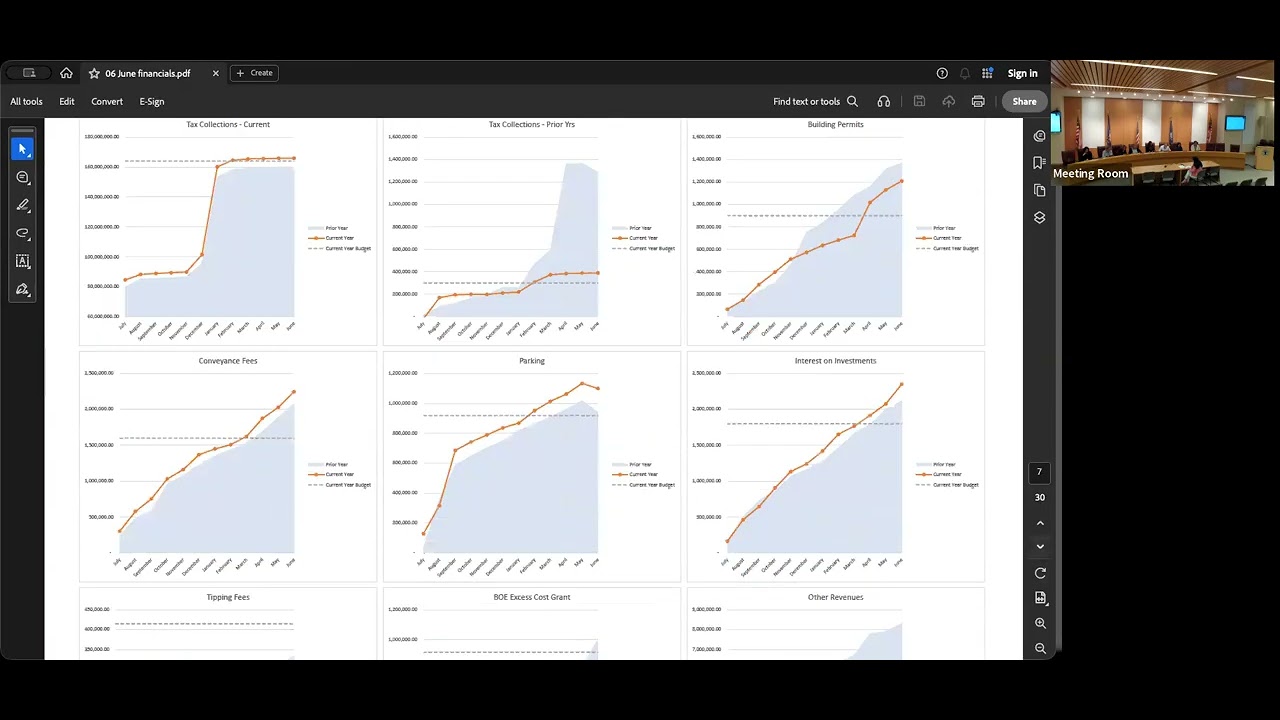
On the revenue side, overall year-to-date revenue was $179.8 million, 102.6 percent of budget. Current tax collections were $166 million, 101.2 percent of budget, with a collection rate Stacy put at roughly 99.7 percent. Prior-year tax collections added $390,000, 130 percent of budget. Building permit revenue reached $1.2 million, 134.4 percent of budget. Conveyance fees totaled $2.2 million, 140.5 percent of budget. Parking permit revenue was $1.1 million, which Stacy said was about 119.7 percent of budget. Interest on investments brought in $2.4 million, 130.8 percent of budget. Transfer station tipping fees, a line Stacy said the town has discussed as under-budget "at every meeting we've had for the last year or so," came in at $280,000, 67.5 percent of budget; Stacy noted lower associated expenses offset the shortfall. The state excess-cost special education grant line came in at $173,000, 80 percent of budget, which Stacy said reflects reimbursement formulas that rarely return 100 percent of what districts submit; the town budgets conservatively at 70 percent of the prior year's figure. All other revenue totaled $5.6 million, 128.8 percent of budget.
On expenses, overall spending was $179.2 million, 98.8 percent of budget, including just over $1 million in encumbrances that Stacy said have since come down as departments close out funding they no longer need. The town's working projection showed a $700,000 fund balance increase, but Stacy said the year-end figure is expected to be "significantly better," over $900,000, reversing a budgeted $6.1 million fund balance decrease.
Members asked several follow-up questions. One member asked about "member equity" payments tied to the town's general liability insurance pool, which covers buildings and vehicles rather than employee health coverage; Stacy explained the pool shares profit-and-loss results with member towns annually, and New Canaan received $114,000 two years ago but nothing in other years "because it's a share in their profit and loss." Another member, Kim, asked where parking ticket revenue appears in the budget detail; Stacy pointed her to page nine of the packet, where parking permits, fees and tickets are combined in the general fund detail. A member asked why the excess-cost grant came in under the town's 70 percent projection; Stacy said the state is currently revising its reimbursement formula and it was not yet clear whether the change would help or hurt New Canaan. A member asked whether education grants follow the school-year or fiscal-year calendar; Stacy said the excess-cost and education cost-sharing grants are fiscal-year based, with a formula that sometimes "trues up" after the close of a year, potentially adding another $100,000 to $200,000 on top of the roughly $400,000 to $500,000 base ECS grant. Asked when the town officially closes its books, Stacy said June 30 is the formal date but described a 60-day "look-back" period for revenue and expenditures, plus separate audit adjustments for unrealized gains or losses on the town's investments.
A remote attendee who identified himself as Dale Masters attempted to ask a follow-up question; the presiding officer told him that only town council members may speak during this portion of the meeting, since the public comment period had already closed, and invited him to email the council instead. Council member Christina, described as sitting in the room, then asked whether the town or the elected treasurer manages the unrealized gains and losses on investments; a finance staffer said the town reconciles the accounts monthly but that the treasurer places longer-maturity investments of five to ten years, while the finance office manages roughly $20 million in short-term, three-to-four-month investments freed up after tax season.
2026-2027 Meeting Schedule Approved With Holy Week Adjustments
A council member moved approval of the proposed 2026-2027 Town Council meeting calendar; Hillary seconded. The schedule was built around school vacations and religious holidays, and members raised two changes before voting: moving up the start time of the March 25, 2027 meeting because it falls on Holy Thursday, matching an accommodation made the previous year, and moving up the April 1 meeting, a 5:30 p.m. public hearing, as early as members could manage. One member, Jennifer, noted the schedule has her attending a meeting on March 30 instead of marking her birthday, drawing laughter. With the two timing adjustments, the council voted to approve the calendar unanimously as amended.
AARP Age-Friendly Designation
Council member Kim Norton, joined by HHS Commission members John Knight, who was not present, and Jen Laddick, along with HHS Chair Barb Aachenbaum, presented a two-minute update announcing that New Canaan has been accepted into the AARP Network of Age-Friendly States and Communities. The background: the Human Services Commission's subcommittee on senior behavioral health had been examining how the town supports residents as they age, and the network membership emerged from that work. The question before the council was not a formal vote but a report seeking the body's continued backing of an initiative it had already supported.
Norton said the designation gives New Canaan access to national research, best practices and a network of communities working to become more livable "for everyone," not only older residents, with focus areas including housing, transportation, walkability, accessibility and social connection. She cited a concrete funding opportunity: AARP is awarding 750 community challenge grants in 2026 totaling a record $8.3 million for projects involving housing, transportation, public spaces and other livability improvements. She credited the late Jim Lisher for first recommending New Canaan join the network, saying he "understood the importance of looking ahead and making sure New Canaan remains a community where people can live and thrive throughout every stage of life." Norton and Aachenbaum plan to complete a free online course through Ohio State University on the program's resources and grants. Norton also thanked Town Council Chair Mike Morrow, who joined the meeting remotely, for championing the application, and thanked the full council for its unanimous support. The presiding officer added that the idea originated with Norton and thanked her for pursuing it.
Committee Reports
Bylaws and Ordinance: The committee chair said she would be soliciting meeting dates to address several pending items: drafting an ordinance related to formalizing a town department's status, reviewing a resident veteran's suggestion for property tax abatement initiatives for veterans, and deciding whether to undertake a full review of the town's ordinances to remove outdated provisions. She said a full review would likely require engaging outside legal counsel beyond the town attorney's current retainer scope, a budget consideration for next year, and that she hopes to complete the project within her two-year term.
Education: A council member reported that schools opened the year with enrollment roughly flat rather than the significant increase officials had projected; final enrollment numbers are expected in October. West Elementary School added a new kindergarten section to absorb the growth that did occur, and the preschool program was reconfigured, with roughly half now located at West and half at South. Districtwide staffing was also flat, with 40 departures or retirements offset by 40 new hires. The Board of Education used about 99.5 percent of its budget for the school year.
The member said a "brewing" issue is parent concern over artificial intelligence use in classrooms, discussed at recent Board of Education meetings, covering both AI as a teaching tool and student use of AI on assignments as early as kindergarten. She said the district plans a formal study led by Director of Technology and Innovation Melinda Meyer, incorporating parent and student survey feedback, and that the high school already uses detection software that can result in a zero on a paper if AI use is found. Another member noted a comparable "national movement" around AI in schools and referenced concerns raised in Norwalk schools. The member also reported that, following an October 2025 ruling by a state Freedom of Information Commission that New Canaan must publicly notice and post minutes for curriculum meetings, the Board of Education has now held three such meetings, posted on the Board of Education's own website rather than the town calendar. She called the change good for transparency, allowing parents to weigh in when programs like new math curricula roll out and letting taxpayers see how dollars are spent.
Health Department Report: A council member shared a report from the health department, credited to Amy Lenny, summarizing the department's past year of work: more than 200 food-safety inspections, nearly 500 development reviews for building permits, certificates of occupancy and zoning, 118 ticks submitted for testing with 46 testing positive for Lyme disease, 21 public pool inspections, 25 cosmetology inspections, seven daycare inspections, 33 public health programs, 43 health screenings, eight suicide-prevention trainings, nine vaccine clinics and seven Medicare counseling sessions.
Infrastructure and Utilities: The committee has not yet met this season; meetings begin next month on a set calendar, the Friday before each Town Council meeting, at 11 a.m.
Land Use, Recreation and Conservation: A council member reported attending a Parks and Recreation Commission meeting, anticipating a large turnout on a separate matter, and said the Waveney Conservancy, now chaired by Val Herdig, is nearing a request for a Parks and Recreation vote on a trails refurbishment plan along the Waveny grounds, following a presentation given the prior year. A commission member, George Bennington, raised questions about the plan's effect on the high school cross-country meet schedule, and some commission members want additional data before voting; once a vote occurs, the matter would return to the council to release previously held funds. The same member praised a new naturalist at the Lapham Community Nature Center, identified as Kathy, for community outreach and encouraging visitors of all ages to attend programs there. A second council member reported attending a Conservation Commission meeting that included public comment and said a resolution from that commission had been circulated to council members by email for review.
Public Safety: A council member addressed lingering questions about the July 4 fireworks and their aftermath, saying the town's emergency management and fire officials "acted honorably and with the best information that they had at the time," acknowledging a post-mortem review had taken place and that some things might have been handled differently, but concluding the response was strong overall.
Affordable Housing Committee: A member reported the committee met Monday, September 14, 2026, and is dividing responsibilities to prepare a report for the Board of Selectmen recommending possible affordable housing sites, incorporating results of a public survey. Asked how many responses the survey drew, Christina said it was 452 responses, calling the number strong for a long survey, with a high completion rate. The survey was open online to any interested resident or household rather than mailed to a fixed list.
Closing Note
Before adjourning, a council member, Tucker, praised a wine shop on Morse Court called Taste Again, saying he had no business affiliation but wanted to highlight the shop and its proprietor's knowledge and offerings, including private tastings, tours to Italy and rentable in-home events. The council then voted to adjourn.
Town Council members present: Maria (led the pledge of allegiance; seconded the minutes motion); Christina (confirmed in the room; asked about investment management and affordable housing survey turnout); Kim Norton (presented the AARP update); Jennifer (asked budget and curriculum-transparency questions); Hillary (seconded the meeting-schedule motion); Tucker (closing remarks on a local wine shop); Eric (acknowledged during the financial Q&A, no additional questions); a council member serving on the Bylaws and Ordinance, Education, Land Use/Recreation/Conservation, Public Safety and Affordable Housing committees who gave reports without a surname confirmed in the transcript.
Attending remotely: Town Council Chair Mike Morrow and a member identified as Penny, both described as joining from a different time zone.
Absent: Health and Human Services Commission member John Knight, noted as unable to attend.
Town staff in attendance: Ryan Stacy and Kelly Lentz, who presented the financial update (specific titles not stated in the transcript).
Named but not confirmed as council members or staff: a person addressed as "Claudia" early in the meeting, in a context suggesting a clerk-related role, and "Nick," referenced regarding a planned ordinance review, possibly outside or town legal counsel; both require editor confirmation.
Public and outside participants: Wendy, a recurring gallery attendee who declined to comment; Dale Masters, a remote attendee who asked a procedural question during the financial Q&A and was told only council members could speak at that point; Val Herdig, chair of the Waveney Conservancy board; George Bennington, who raised cross-country scheduling questions at a Parks and Recreation Commission meeting; Kathy (surname not given in the transcript), a new naturalist at the Lapham Community Nature Center; Melinda Meyer, the school district's Director of Technology and Innovation, referenced regarding a planned AI study; Amy Lenny, credited with the health department's annual report; John Knight, Jen Laddick and Barb Aachenbaum of the Health and Human Services Commission, referenced in connection with the AARP application; the late Jim Lisher, credited with originating New Canaan's interest in the AARP network.
AARP Network of Age-Friendly States and Communities — the designation New Canaan was accepted into, discussed in the Human Services Commission update. Ohio State University — offers the free online course Norton and Aachenbaum plan to take on age-friendly program resources. Board of Finance — received the July 2026 presentation of the financial figures the council reviewed Wednesday. Board of Education — source of the enrollment, staffing, budget and curriculum-meeting information discussed under the education committee report. State Freedom of Information Commission — ruled in October 2025 that New Canaan must publicly notice and post minutes for curriculum meetings, cited in the education report. Waveney Conservancy — nonprofit group, now chaired by Val Herdig, preparing a trails refurbishment proposal for Parks and Recreation Commission approval. Lapham Community Nature Center — site where a new naturalist was praised for community programming. New Canaan Cares — mentioned briefly as offering a free community talk, without further detail in the transcript. Taste Again — the Morse Court wine shop praised in closing remarks. Town's general liability insurance pool — the "member equity" dividend arrangement discussed during the financial Q&A; the transcript's rendering of the vendor's name is unclear and should be confirmed before publication. Council member's dissent memo on the August 12, 2026 special meeting's "question six" — referenced during the minutes discussion, submitted to the council secretary and town clerk. Public affordable housing site survey — cited by the Affordable Housing Committee, 452 responses, referenced ahead of a forthcoming report to the Board of Selectmen. Health department annual report, credited to Amy Lenny — cited for public health inspection and program statistics.